
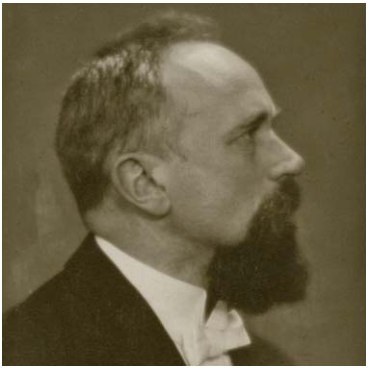
Alfrēds Kalniņš
1879 – 1951
- Cemetery
- Forest Cemetery / Meža kapi, Riga, Latvia
Alfrēds Kalniņš combined a career as an organist with composition and musical education. His opera Baņuta became a landmark in Latvian stage music, while his songs and instrumental works reached audiences beyond the opera house. Employment in different cities, including a period in the United States, exposed him to varied musical environments. He nevertheless maintained a strong relationship with Latvian texts, performers and institutions. His work helped broaden the range of forms available to a developing national musical culture. Born in Cēsis on 23 August 1879, Kalniņš received his early schooling at the nearby Bērzaine German Grammar School and at a science-oriented school in Cēsis. His first musical understanding developed there. Between 1895 and 1897 he attended A. Berlin’s private music school, began composing and even sold copies of his music. Further study followed in St Petersburg from 1897 to 1901, concentrating on music theory and the organ. By 1904 his songs and instrumental compositions were appearing in print in both Riga and Leipzig. [2] Teaching appointments took him to Pärnu from 1903 to 1911 and then to Liepāja until 1915. During these years his songs became widely performed by Latvian singers, while instrumental pieces, cantatas and suites also attracted attention or reached publication. In Liepāja he helped secure the construction of an organ by E. F. Walcker & Co. for St Anne’s Church in 1913. The instrument had four manuals and fifty-six registers. War subsequently displaced him to Dorpat, now Tartu, and he performed in Moscow and other Russian cities before returning to Liepāja in 1918. [2] An encounter in 1918 with the lawyer and arts patron A. Frīdenbergs helped redirect his attention towards opera. Frīdenbergs was organising the renewed Latvian Opera, and Kalniņš took up a libretto that the architect Artūrs Krūmiņš had written in 1903. The resulting Baņuta was composed in 1919 and first performed on 29 May 1920, with Kalniņš conducting. His son Jānis conducted its renewed staging in 1937. A production under Soviet occupation in 1940 required the composer to replace the original conclusion with a happy ending, demonstrating the direct effect of political authority on the work’s presentation. [2] Further stage compositions followed. Kalniņš wrote Salenieki in 1922, and the opera received its première in 1926. His ballet Staburags, composed in 1939–1940 to a libretto by Eižens Leščevskis, was first staged on 24 November 1943. It was Latvia’s first full-length ballet in several acts. A substantially altered version appeared in 1957 under the title Staburadze. Vocal music remained equally important: his output included 240 solo songs, and he founded and conducted the choir Dziesmuvara. He also served as chief conductor of the Sixth All-Latvian Song Festival. [2] Together with Jāzeps Vītols, he established the Latvian Composers’ Group in 1923. His professional circumstances changed when opposition from German clergy to his Riga church concerts contributed to his departure for New York in 1927. There he worked as an organist, conductor and teacher until 1933, also performing in Philadelphia and Boston. Four organ compositions were taken up by Samuel Atkinson Baldwin and other performers. Returning to Riga in the summer of 1933, he became an organist at the Dome and resumed teaching. Latvia awarded him the Order of the Three Stars in 1926 and again in 1937. [2] In 1944, after Vītols left Latvia, Kalniņš became professor and rector of the State Conservatory. Following the war, he also participated in re-establishing the Latvian Composers’ Union. Baņuta was first recorded in 1947, and its 1953 revival led to a tradition of opening the opera and ballet season with it. His mixed-choir songs continued to be performed at national Song Festivals, while his concerts helped establish the Dome’s organ recital tradition. He was buried in Riga’s Forest Cemetery, leaving a legacy sustained through performance as well as through musical institutions. [2]
The book A Hundred Great Latvians, which includes this person, can be purchased here.
The map marker shows the cemetery; the exact grave position is not yet established.
Sources & Further Reading
Books
- [2] Apinis, P. A Hundred Great Latvians. Nacionālais apgāds, Riga, 2006, pp. 78-79. ISBN 9984-26-288-X.
Web resources
- [1] Alfrēds Kalniņš