
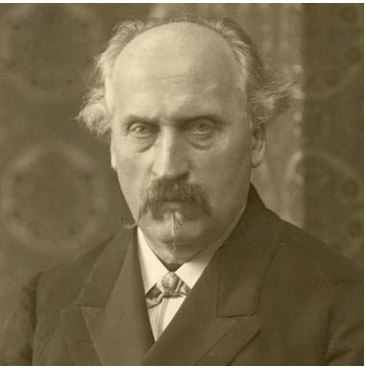
Andrejs Jurjāns
1856 – 1922
- Cemetery
- Forest Cemetery / Meža kapi, Riga, Latvia
Andrejs Jurjāns connected professional composition with the collection of Latvian traditional music. Trained in St Petersburg, he worked for many years in Kharkiv while maintaining strong links with musical life in Latvia. Teaching, performance, criticism and research all formed part of his career. His folk-music collections supplied material for later scholarship and composition, while his choral and orchestral works helped broaden the possibilities of Latvian concert music. The work depended on attention to melodies encountered outside elite musical institutions as well as mastery of professional forms. Jurjāns also participated in the Song Festival tradition. His career shows how a person working abroad could remain closely involved in the development of Latvian culture, bringing experience from one musical setting into another. Jurjāns was born on 30 September 1856 at the Meņģeļi farmstead near Ērgļi. Music was already part of the household: his father Andrievs played a violin he had made himself, while his mother Annuža knew numerous folk songs that her son later wrote down. He attended the parish schools of Ērgļi and Vecpiebalga. In 1873 he travelled to the First All-Latvian Song Festival as a member of the Vecpiebalga Charity Choir, participating as a young singer in an institution he would later help organise and conduct. [2] His conservatory training began in St Petersburg in 1875 and led to three separate qualifications. He completed L. Homilius’s organ class in 1880, N. Rimsky-Korsakov’s composition class in 1881 and F. Homilius’s French horn class in 1882. He was already composing songs as a student. In 1880 he also wrote two early landmarks in Latvian orchestral music: a march for the national Song Festival and a Symphonic Allegro conceived as the first movement of an F minor symphony. The festival march received its first performance at the Third All-Latvian Song Festival in Riga in 1888. [2] The four Jurjāns brothers developed different but connected musical careers. Pēteris, the eldest, worked with instruments as a maker, tuner and shop proprietor, and taught himself the horn rather than receiving higher musical training. Juris later established the French horn class at the Latvian Conservatory. Pāvuls pursued singing, conducting and composition, and became involved in the foundation of Latvian opera and the Conservatory. Together, the brothers formed a horn quartet that appeared at the 1888 Song Festival and subsequently performed successfully both within Latvia and beyond its borders. [2] Andrejs began gathering Latvian folk songs in the early 1880s, organising a broad network of collectors rather than relying solely on material he could record himself. Approximately three thousand melodies were collected and systematised. The results appeared in six instalments of Latvian Folk Music Materials, published between 1894 and 1926, with the final publication following his death. The collection provided detailed descriptions of the songs and addressed their classification and historical grouping. His work therefore involved not only preserving melodies but also developing methods through which Latvian traditional music could be studied systematically. [2] In 1882 he took up work at the Kharkiv Music School, teaching theory, horn and singing over a long period. Illness eventually forced his retirement in 1916. His compositional output included thirty-four original choral songs, more than a hundred arrangements of folk melodies and five cantatas, among them Tēvijai. Themes of homeland and attachment to his people recur in the choral works. Folk melodies also entered his symphonic writing, extending their use beyond vocal arrangements. Alongside composition and teaching, he performed abroad as a soloist and contributed to the development of Latvian music criticism. [2] Despite his residence in Kharkiv, he belonged to the Riga Latvian Society’s Music Commission and helped organise the national Song Festivals of 1888, 1895 and 1910, serving as a chief conductor. The Latvian Conservatory recognised his achievements by electing him its first honorary member. He returned to Latvia in late 1920 and died on 28 September 1922, with burial in Riga’s Forest Cemetery. The publication of his folk-music materials continued beyond his lifetime, preserving a body of research that accompanied his contributions to choral performance, orchestral composition and musical education. [2]
The book A Hundred Great Latvians, which includes this person, can be purchased here.
The map marker shows the cemetery; the exact grave position is not yet established.
Sources & Further Reading
Books
- [2] Apinis, P. A Hundred Great Latvians. Nacionālais apgāds, Riga, 2006, pp. 38-39. ISBN 9984-26-288-X.
Web resources
- [1] Andrejs Jurjāns