
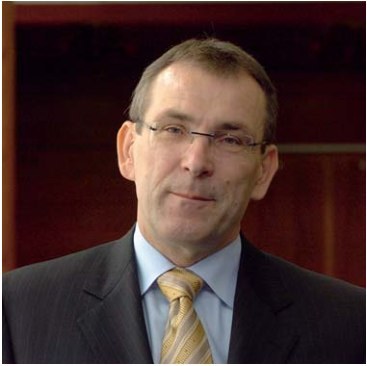
Andris Piebalgs
1957 –
Andris Piebalgs moved from education into public administration and diplomacy during Latvia's transition toward restored independence and European integration. His experience included national government and diplomatic assignments before service at the European Commission. He was European Commissioner for Energy from 2004 to 2010 and for Development from 2010 to 2014. These portfolios involved different but connected international questions: energy relationships, institutions and cooperation with countries beyond the European Union. His career forms part of the story of Latvian officials taking roles in European governance after accession. Born in Valmiera on 17 September 1957, Piebalgs studied physics at the University of Latvia, completing his degree in 1980. He spent the next eight years at Valmiera Secondary School No. 1, first teaching and subsequently serving as headmaster. His next appointment, as a department director in Latvia’s Ministry of Education, extended his responsibilities beyond a single school. During the late 1980s he also participated actively in the Latvian Popular Front, the movement campaigning for the restoration of Latvian independence. [2] In 1990 Piebalgs became Minister of Education in the newly established Latvian government. The reforms undertaken during his leadership changed the orientation of schooling: institutions organised around Soviet youth organisations were redirected towards European educational traditions and greater attention to the individual pupil. His parliamentary career began with election to the fifth Saeima in 1993. There he chaired the committee responsible for budgetary and financial questions, before taking office as Minister of Finance for the period from 1994 to 1995. [2] Rather than stand again for parliament, he entered diplomatic service. His first ambassadorial posting was to Estonia, where he served from 1995 to 1997. A photograph from that assignment records him signing a Latvian–Estonian agreement concerning cooperation in social security. In February 1998 he received Estonia’s second-class Order of the Cross of Terra Mariana. From 1998 until 2003 he represented Latvia as ambassador to the European Union, followed by appointment as Under Secretary of State for European Union affairs at the Ministry of Foreign Affairs. [2] Latvia’s accession on 1 May 2004 brought a change in the institutional setting of his work. The country joined alongside Estonia, Lithuania and seven other states, entering a Union that then comprised twenty-five members. Sandra Kalniete became Latvia’s first commissioner and initially worked alongside Agriculture Commissioner Franz Fischler. Piebalgs headed her office. Later that year, when a new Commission was assembled, he was nominated for the energy portfolio and received confirmation in November. These appointments placed him within the Commission after years spent representing Latvia to it. [2] On taking responsibility for energy, Piebalgs identified reliable supplies and affordable electricity and gas as central objectives. The policy setting included Europe’s increasing reliance on fuel imported from elsewhere. He sought to address that dependence while balancing it against demand within the Union. Environmental commitments were another part of the portfolio, particularly the reductions in carbon dioxide emissions undertaken through the Kyoto Protocol. More efficient consumption and greater use of renewable resources were presented as ways to meet those obligations. Nuclear reactor safety was also a priority, since nuclear generation then supplied approximately one-third of the Union’s electricity. [2] The chapter’s photographs document several occasions associated with these responsibilities. Piebalgs met United States President George Bush during the president’s visit to the European Commission on 22 February 2005. On 8 March 2006 he appeared with Commission President José Manuel Barroso to present the European Union’s energy strategy. A further image places him on a North Sea oil platform in July 2006 with Talisman Energy president Jim Buckee. Together, these records show the diplomatic, strategic and industrial settings in which his early Commission work took place. [2]
The book A Hundred Great Latvians, which includes this person, can be purchased here.
Sources & Further Reading
Books
- [2] Apinis, P. A Hundred Great Latvians. Nacionālais apgāds, Riga, 2006, pp. 202-203. ISBN 9984-26-288-X.