
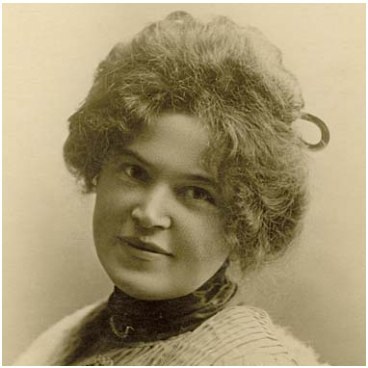
Aspazija
1865 – 1943
- Cemetery
- Rainis Cemetery / Raiņa kapi, Riga, Latvia, beside Rainis
Aspazija, the pen name of Elza Pliekšāne, made women’s choices and social constraints central subjects of Latvian literature. Her plays challenged conventions about marriage, respectability and personal freedom, while her poetry brought an intense individual voice into public life. Her partnership with Rainis joined two distinct literary careers. They experienced political repression and exile, lived in Switzerland, and returned to Latvia in 1920. Aspazija also served in the Constituent Assembly, participating directly in the establishment of the republic. Her work deserves attention in its own right, beyond the role of a famous writer’s spouse. In her later years she continued writing and contributed to the preservation of Rainis’ legacy. Born on 16 March 1865 at the Daukšas farmstead in Zaļenieki, she was originally named Johanna Emīlija Lizete Rozenberga. Her schooling took place in Jelgava, where she read German fiction and poetry and acquired sufficient command of the language to write poems in German herself. Her early biography is difficult to reconstruct: she altered the recorded year of her birth by three years, changed her name and destroyed documents from her adolescence. Researchers later encountered conflicting evidence concerning this period, including her first marriage to Vilhelms Maksis Valters. [2] Her earliest play, Atriebēja, was written in 1887, and her poems began appearing in newspapers in 1888. In 1893 she joined the Riga Latvian Theatre and concentrated on writing and journalism. Public recognition followed in 1894 with Vaidelote and Zaudētas tiesības. Dace Akmentiņa’s portrayal of Mirdza in Vaidelote is among the theatrical performances documented in the chapter. Together with Neaizsniegts mērķis, these early dramas belonged to a body of work shaped by the literary traditions associated with Schiller and Byron. [2] Work at the newspaper Dienas Lapa brought her into another important setting for literary and political activity. She supported Jaunā strāva, the New Current social democratic movement, and publicly defended women’s rights at a time when such advocacy was unusual in Latvian society. In 1894 she met Jānis Pliekšāns, then a lawyer and editor. Their relationship developed alongside his emergence as the poet Rainis. Her practical contribution to his writing included editing and supplementing his texts and assisting with the creation of his major dramatic works. [2] Their marriage took place in prison in December 1897, after Rainis had been arrested in connection with the New Current movement. When he was sentenced to deportation, she spent periods with him in Pskov and Slobodsk. Following the revolutionary events of 1905, they lived in Castagnola beside Lake Lugano from 1906 until 1920. Throughout these years, Aspazija maintained a substantial literary output of her own. Beginning in 1897, she published more than ten poetry collections and a comparable number of volumes of selected verse during her lifetime. [2] Her activities also included prose and extensive translation from German, Russian and Polish literature. Among the authors whose works she brought into Latvian were Henryk Sienkiewicz, Robert Hamerling and Johann Wolfgang von Goethe. In April 1920 she and Rainis arrived in Riga shortly before elections to the Constituent Assembly, welcomed by crowds bearing flowers. In the assembly, her stated concerns included equality between women and men, women’s political rights and making divorce procedures easier. These were specific legislative and civic questions to which she brought the advocacy already evident in her earlier public work. [2] Her later home was in Dubulti, Jūrmala. Although poor health affected the final decade of her life, she continued to write and received the Fatherland Prize in 1939. Photographs from the period preserve both her public associations and her increasingly solitary later years; an earlier image from 1925 records a visit by biographer Antons Birkerts and journalist Alberts Prande. Aspazija died on 5 November 1943 and was buried beside Rainis in the cemetery bearing his name. Held during German occupation, her funeral became a significant public demonstration. [2]
The book A Hundred Great Latvians, which includes this person, can be purchased here.
The map marker shows the cemetery; the exact grave position is not yet established.
Sources & Further Reading
Books
- [2] Apinis, P. A Hundred Great Latvians. Nacionālais apgāds, Riga, 2006, pp. 46-47. ISBN 9984-26-288-X.