
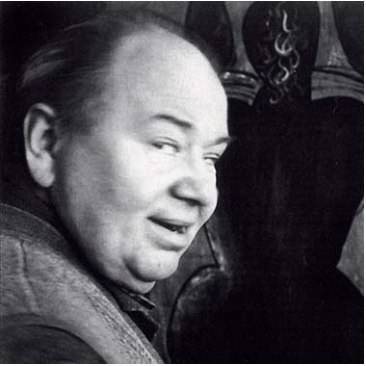
Boriss Bērziņš
1930 – 2002
- Cemetery
- Forest Cemetery / Meža kapi, Riga, Latvia
Boriss Bērziņš developed a distinctive visual world from figures, objects and situations drawn from ordinary life. His work moved among painting, drawing and graphic techniques, often giving familiar subjects an unusual weight, rhythm or sense of humour. Rather than depending on a single genre, he explored the expressive possibilities of different materials and ways of seeing. His career formed part of the development of Latvian art in the later Soviet period and after restored independence. The lasting value of his work lies in the individual character of the images as well as in their place within that history. He died in Riga in 2002. Bērziņš was born in Riga on 7 October 1930, and his father first encouraged his interest in art. His initial instruction came through the art studio at the Riga Pioneer Palace, established by the Soviet authorities in the former presidential castle. There children sketched interiors and practised watercolour, including in rooms previously used by the president. He continued at the Jānis Rozentāls Riga Art School and in the decorators’ department of the Riga Secondary School of Applied Arts, completing the latter course in 1952. [2] In 1959 he graduated from Eduards Kalniņš’s painting class at the Art Academy of Latvia. His generation helped introduce a more generalised and monumental treatment of subjects in easel painting. Rhythmic arrangements, frontal figures reduced to essential forms, broad brushwork and areas of colour became features of what was called the austere style. Working people and Latvian riflemen were recurrent subjects. Under Soviet requirements governing acceptable themes, experimentation often concentrated on the formal construction of pictures rather than on unrestricted choices of subject matter. [2] During the 1970s Bērziņš moved away from the conventions of that style. In one phase he applied paint straight from its tube, creating robust images with an emphasis on the physical qualities of the medium. By the later part of the decade, landscapes and still lifes occupied more of his attention, with colour and surface texture taking particular importance. His palette also changed over time: the stronger colours and textured handling of early work gave way to more restrained arrangements of warm golden browns, black and white, or blue and white. [2] The range of his materials is visible in individual works reproduced in the chapter. In the Dunes, dated 1980, combines oil and gold on cardboard; Funeral for a Pig, also from 1980, uses oil, tempera and gold on wood. In the Artist’s Studio, painted in 1985, brings oil, tempera and gold together on cardboard. The lithograph A Back, from 1980, represents another side of his practice. Alongside oil and tempera, he worked in watercolour and pastel, and his professional activity included monumental painting and illustrations for the press. [2] He began exhibiting in 1956 and received awards at international exhibitions, including drawing biennials in Middlesbrough in 1979 and 1983. His solo exhibitions included presentations in Lviv, Riga, Liepāja, Kuldīga, Lēdurga, Chelyabinsk and Moscow. Teaching became another sustained responsibility: he joined the Art Academy’s staff in 1963, became an assistant professor in 1977 and a professor in 1986. From 1988 he headed its creative painting studio, supervising postgraduate artists. He also held elected leadership positions in the Art Foundation and became a corresponding member of the Soviet Union’s Academy of Arts in 1988. [2] Later recognition included honorary membership of the Latvian Academy of Sciences in 1994, the Order of the Three Stars in 1995 and the Spīdola Prize for his lifetime contribution to painting in 2000. He was buried in Riga’s Meža kapi, and a commemorative exhibition opened a year after his death. The largest part of his artistic estate entered the Latvian National Museum of Art. Other works are held by the Latvian Art Foundation and in collections in Britain, France and the United States, documenting the geographical reach of his surviving work. [2]
The book A Hundred Great Latvians, which includes this person, can be purchased here.
The map marker shows the cemetery; the exact grave position is not yet established.
Sources & Further Reading
Books
- [2] Apinis, P. A Hundred Great Latvians. Nacionālais apgāds, Riga, 2006, pp. 150-151. ISBN 9984-26-288-X.