
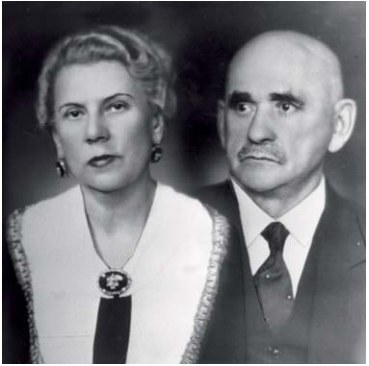
Emīlija Benjamiņa
– 1941
- Cemetery
- Died in the Usollag camp system, Soviet Union
Emīlija Benjamiņa built an influential position in Latvian public life through newspaper and magazine publishing. With Antons Benjamiņš, she developed the business behind Jaunākās Ziņas and Atpūta. Her activity combined commercial organisation with patronage and the creation of spaces where writers, artists and public figures met. The prominence of their publications made her a major participant in interwar Riga’s cultural world. Soviet occupation brought nationalisation and the loss of her property. In June 1941 she was deported; she died that September in the Usollag camp system. Her story connects the expansion of the Latvian press with the violent destruction of individual lives and institutions under occupation. The place of death does not establish a recoverable individual grave, so the burial field remains unresolved. Born in 1881, Emīlija was known as Emīlija Simsone when she and Antons Benjamiņš launched a newspaper priced at one kopeck in 1911. Their responsibilities were distinct: she acted as publisher, while he served as editor-in-chief. The enterprise attracted both readers and advertisers. During the First World War, notices seeking missing relatives became an important part of its appeal, as more than half a million Latvians sought refuge in Russia. Despite interruptions, publication continued through the wartime period. [2] Advertising was central to Emīlija’s business practice. Under her management, advertisements supplied most of the revenue from the couple’s periodicals, allowing comparatively inexpensive selling prices and helping circulation grow. By the late 1930s, Jaunākās Ziņas sold about 200,000 copies in a country with roughly two million inhabitants. The editorial operation drew on prominent writers, poets, artists and photographers. Jānis Kārkliņš and Ernests Arnis were among its editors, while the staff included figures such as Kārlis Skalbe and Jūlijs Lācis. [2] The couple married in 1922, and their commercial interests extended well beyond the newspaper office. They owned stationery shops, the Burtnieks ink factory, bookbinding and zincography businesses, and six-storey residential properties. The chapter puts the combined daily net profit of these holdings at 10,000 lats. In 1924 they added the weekly Atpūta to their publishing activities. Their residences included the Pfab house at 12 Krišjāņa Barona Street in Riga, two cottages in Jūrmala, and the Valdeķi country property near Kandava. [2] Their Riga home hosted diplomats, military attachés, visiting film personalities and members of the city’s cultural circles. Performances in Emīlija’s salon could bring young artists the attention of the newspaper, linking social gatherings with opportunities for publicity. She and Antons also supported Latvian writers and poets during the 1930s. In 1936 she proposed a Press Party to assist the renovation of the Writers’ Palace. The occasion subsequently became a leading annual event in pre-war Latvian society, adding a public fundraising initiative to her private hospitality. [2] After Kārlis Ulmanis’s coup in 1934, Emīlija sometimes acted as hostess at state and social functions, assuming a ceremonial role associated with a first lady while the president remained unmarried. Her public activities also included honorary membership of the Latvian Women’s League and participation in the Jūrmala Society for Assistance and Improvement. She received the Order of the Three Stars and a first-class medal of Sweden’s Order of Vasa. These distinctions accompanied her commercial prominence and her involvement in cultural and civic organisations. [2] After being expelled from her large home under Soviet rule, she lived in a small flat. She sought meetings with Vilis Lācis, Jūlijs Lācis and Augusts Kirhenšteins, men she had previously supported who now held positions of authority, but none received her. She remained in Latvia despite advice to leave. Armed men came to her flat on the night of 14 June 1941 and took her to a deportation train. Vilis Lācis, formerly a reporter for her newspaper and subsequently commissar of the interior, had signed the deportation order. She was taken away wearing a summer dress and without food supplies. [2]
The book A Hundred Great Latvians, which includes this person, can be purchased here.
The resting place has not yet been established.
Sources & Further Reading
Books
- [2] Apinis, P. A Hundred Great Latvians. Nacionālais apgāds, Riga, 2006, pp. 44-45. ISBN 9984-26-288-X.