
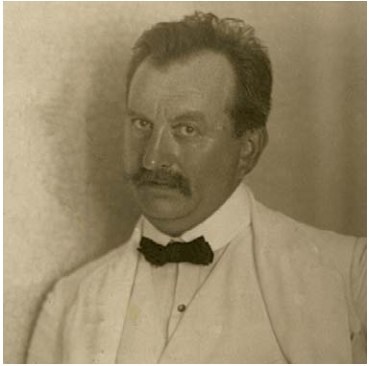
Emilis Melngailis
1874 – 1954
- Cemetery
- Forest Cemetery / Meža kapi, Riga, Latvia
Emilis Melngailis treated traditional music as a living source for composition and performance. His collecting work preserved melodies encountered in communities, while his choral arrangements brought that material to new audiences. He was also closely involved in the Latvian Song Festival tradition. His training and employment took him beyond Latvia, but research into Latvian folk music remained a defining concern. Collections such as Birzēs i norās reflect the connection between fieldwork and artistic creation. Melngailis’ career demonstrates that preservation need not mean leaving music untouched: careful study could support new performances while keeping older melodic traditions audible. He died in Riga in 1954. Born in Vidriži parish on 15 February 1874, Melngailis completed his education at Riga Grammar School No. 1 in 1893. He subsequently studied at the Dresden Conservatory and then at the St Petersburg Conservatory, graduating from the latter in 1901. In St Petersburg his composition teacher was Nikolai Rimsky-Korsakov. His career included lengthy periods of residence and work abroad, including time in Tashkent with his family. During holidays, he travelled through Latvian regions to gather melodies from local singers. [2] His collecting began on a small, personal scale: in 1896 he wrote down two Līgo songs sung by his mother. Eventually he recorded and worked on nearly five thousand Latvian melodies and variants. During journeys throughout Latvia in the 1920s, he documented more than the tunes themselves. He photographed singers and their surroundings, and paid close attention to the dialect forms appearing in song texts. His records therefore included details of language and local setting as well as the musical material performed for him. [2] This work belonged to a broader development in Latvian professional music. Jānis Cimze had begun collecting and arranging folk songs for choirs in 1869, and the years around 1900 brought extensive activity in musical folklore. Melngailis’s nine notebooks of Birzēs i norās began appearing in St Petersburg in 1902. Later publications included Latviešu dancis, issued in Riga in 1949, and the three volumes of Latviešu mūzikas folkloras materiāli, published between 1951 and 1953. His scholarly publication of collected material encompassed approximately 4,500 items. [2] His interests were not confined to Latvian traditions. In the summer of 1899, he recorded 120 Jewish folk songs in a Lithuanian village, and during his St Petersburg studies he listened closely to songs performed by his friends. The chapter identifies this attention to other peoples’ musical heritage as a distinguishing feature of his work. In his choral arrangements he developed each vocal part and used practices drawn from traditional multipart singing. Folk-derived and newly composed melodies could be closely interwoven within his own musical language. [2] Mixed-choir music occupied a particularly large place in his output, although he also composed forty-five solo songs, ballet and symphonic works, string-quartet music and pieces for piano. His organisational responsibilities were equally substantial. He helped organise and served as a principal conductor at the sixth through ninth All-Latvian Song Festivals, later becoming an honorary principal conductor at the tenth and eleventh. In 1923 he joined Jāzeps Vītols, Alfrēds Kalniņš and Jānis Mediņš in establishing a composers’ group concerned with raising the artistic standard of the festivals. [2] Melngailis also wrote extensively about music, publishing some 250 reviews, essays, critical pieces and polemical articles in Latvian, Russian and German. He received a professorial qualification in 1946 and began teaching folklore at Latvia’s State Conservatory in 1948. His burial place is in Riga’s Forest Cemetery. Commemoration extends to a museum at the Melngaiļi farmstead in Igate, within the Vidriži municipality, where his old square piano remains playable. A secondary school in Liepāja bears his name, as does an annual chess tournament in Vidriži, recalling his participation in organising Latvian chess as well as playing it. [2]
The book A Hundred Great Latvians, which includes this person, can be purchased here.
The map marker shows the cemetery; the exact grave position is not yet established.
Sources & Further Reading
Books
- [2] Apinis, P. A Hundred Great Latvians. Nacionālais apgāds, Riga, 2006, pp. 70-71. ISBN 9984-26-288-X.