
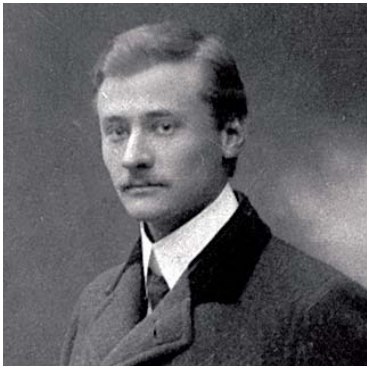
Friedrich Zander
1887 – 1933
- Cemetery
- Kislovodsk city cemetery, Russia, as reported by the book
Friedrich Zander, also known as Frīdrihs Canders or Tsander, pursued the possibility of travel beyond Earth when it remained an experimental ambition. Born and educated in Riga, he developed interests in aviation, propulsion and the practical problems of rocket flight. His later work in the Soviet Union joined theoretical proposals with engine and rocket experiments. He contributed to the early research environment from which subsequent space programmes developed, although he died before seeing many of those ambitions realised. His story links Riga’s engineering education with the international history of astronautics. Zander’s early surroundings included both scientific scholarship and an expanding engineering industry. He was born on 23 August 1887 into the family of Artur Zander, a Baltic German physician and scientist who headed the natural sciences department at Riga’s Museum of Natural History. Friedrich completed Riga’s science-oriented Realschule in 1905 as its leading pupil. The chapter also records his graduation from the Royal Higher Technical School in Danzig in 1907. In 1914 he completed the mechanics programme at Riga Polytechnical Institute with the highest distinction. [2] Riga offered opportunities to encounter aircraft construction directly. The institute’s teaching staff included chemist Paul Walden, mathematician Piers Bohl and aviation-engine specialist Theodor Kalep. At the Motors factory, where Kalep directed aircraft and engine production, Zander received practical instruction in building aeroplanes. He also constructed aircraft during his student years, including a glider documented in 1909. After graduation he worked at the Provodnik rubber factory. As the wartime front approached Riga, the plant was evacuated to Moscow in 1915, and his subsequent research career became centred there. [2] An attempt to return to Latvia in 1920 was unsuccessful. In 1921 Zander met Vladimir Lenin, who supported his efforts in Soviet rocketry, and presented a proposed interplanetary vehicle at a Moscow regional inventors’ conference. His design combined features of an aircraft and a rocket. He developed this approach in a 1924 article about travel to other planets, proposing such a combination as a means of departing Earth. Alongside these investigations, he carried out technical calculations for internal-combustion engines. He joined the Aviation Trust’s Central Design Office in 1926 and began teaching at the Moscow Institute of Aviation in 1930. [2] Experimental propulsion became a sustained part of his work from 1928. Between 1929 and 1932 he directed development of the OR-1 rocket engine. From 1931 he led work by the Group for the Study of Jet Propulsion in Moscow at the Institute of Aviation Engines. Its projects included the OR-2 engine and the liquid-fuelled GIRD-X rocket, built in 1933. The chapter documents GIRD-X’s launch on 25 November that year, after Zander’s death. Sergei Korolyov, later a rocket designer, was among the engineers associated with his work and appears with him in a photograph of the OR-2 group. [2] The preservation and accessibility of his research became a separate part of his legacy. Soviet secrecy surrounding rocket development limited publication: only five of his works appeared during his lifetime, three concerning space research. After unsuccessful attempts to obtain patents and publish further findings, he recorded results in Russian and German using a shorthand system of his own. More than 9,000 pages remained unread for many years. Researchers found the key to this system in 1969, making systematic examination of the archive possible. The chapter particularly notes the mathematical precision and theoretical competence evident in those papers. [2] Among the proposals associated with Zander was the gravitational manoeuvre, which the chapter connects with its later application by the American interplanetary spacecraft Mariner 10. His career ended with his death in Kislovodsk on 28 March 1933; he was buried in that city’s cemetery. Subsequent commemoration included a lunar crater bearing his name and the Friedrich Zander Award, established by the Latvian Academy of Sciences in 1967 for physics and technical sciences and awarded every two years. In Riga, a monument by sculptor Juris Bajārs also commemorates him on the grounds of the former Technological Equipment Factory. [2]
The book A Hundred Great Latvians, which includes this person, can be purchased here.
The resting place has not yet been established.
Sources & Further Reading
Books
- [2] Apinis, P. A Hundred Great Latvians. Nacionālais apgāds, Riga, 2006, pp. 92-93. ISBN 9984-26-288-X.
Web resources
- [1] Friedrich Zander