
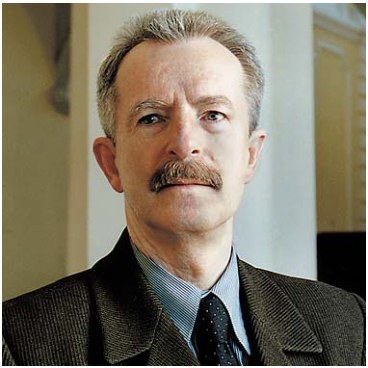
Imants Lancmanis
1941 –
Imants Lancmanis helped turn the restoration of Rundāle Palace into a sustained project of research, craftsmanship and public interpretation. His long leadership of the palace museum involved far more than repairing a building: interiors, collections and historical evidence had to be studied together. His work also includes art history, heraldry and painting. These interests share an attentiveness to visual detail and to the ways objects preserve traces of the past. The recovery of historic architecture in Latvia provided the wider setting for his museum career. His contribution is visible both in the restored environment at Rundāle and in the scholarship that helps visitors understand what they are seeing. Born in Riga on 29 July 1941, Lancmanis completed his schooling at the Janis Rozentāls Art School in 1959. He studied painting at the Art Academy of Latvia from 1960 to 1966. Before graduating, he received an offer in 1964 to work as a research associate at Rundāle, then a branch of the Bauska Museum of Regional Studies and Art. His professional involvement with the palace therefore began while he was still training as a painter, bringing museum research and artistic study into the same period of his early career. [2] The building presented a long and disrupted history. Constructed between 1736 and 1768 for Ernst Johann Biron, Duke of Courland, it was designed and supervised by Francesco Bartolomeo Rastrelli. Francesco Martini and Carlo Zucci supplied paintings, while Johann Michael Graff contributed sculptural decoration. Once owned by the Shuvalov family, the palace passed to the Latvian state through the agrarian reform of 1920. After the destruction of the First World War, it accommodated a school and disabled veterans. Restoration began in 1933, but after the Second World War the building was used under Soviet rule as both a school and a grain store. [2] An independent museum was established at Rundāle in 1972, with Lancmanis initially responsible for scientific work as deputy director. He became director in 1976. Restoration under his leadership had begun in 1972 and encompassed a palace of 138 rooms distributed across two floors, with a total area of 12,000 square metres. His particular contribution lay in the research and methodological direction of the programme. The work addressed ceiling paintings, ornamental decoration, parquet floors, lighting, furniture and the park, with historical authenticity governing the treatment of the ensemble. [2] The museum regularly organised exhibitions on the palace, Latvian history and the Biron family. Lancmanis’s 1994 book Rundāles pils documented the building’s creation, alterations and damage, alongside the progress of restoration and explanations of its architectural and artistic features. Experience gained by him and his colleagues also informed methods for investigating and restoring other Latvian manor houses, palaces and churches. His scholarship ranged across eighteenth- and nineteenth-century Latvian art, country-house architecture, and the history and terminology of heraldry. He wrote monographs on Jelgava and Rundāle palaces and on several other historic estates. [2] From 1970 to 1987, Lancmanis taught the history of decorative applied art in the Art Academy’s Interior Design Department. Painting continued alongside these responsibilities, although his directorship sometimes required him to set it aside. New works appeared during the 1990s, including still lifes, portraits and allegorical compositions. In 1995, when Riga Castle again became the Latvian president’s residence, he painted Sigismund Augustus and Stefan Batory for its gallery of rulers. His paintings also included a scene of Kalēti manor servants, completed in 1996–1998, and Vanitas with the White Butterfly, dated 2004. [2] His scholarly standing was recognised through honorary membership of the Latvian Academy of Sciences in 1992 and an honorary doctorate in art science in 1997. He received the Order of the Three Stars in 1994 and later honours from France, Germany and Italy. The academy awarded him its Grand Medal in 2004 for his contribution to art scholarship and the renewal of Rundāle. The museum itself received a Europa Nostra award in 2003, recognising the institution led by Lancmanis as well as the restoration work associated with his career. [2]
The book A Hundred Great Latvians, which includes this person, can be purchased here.
Sources & Further Reading
Books
- [2] Apinis, P. A Hundred Great Latvians. Nacionālais apgāds, Riga, 2006, pp. 182-183. ISBN 9984-26-288-X.