
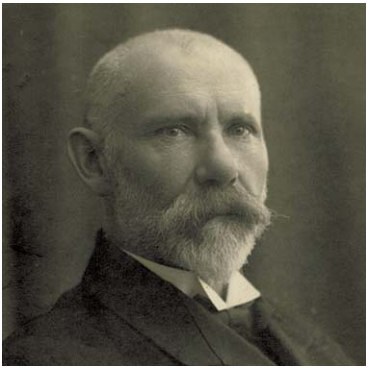
Jānis Čakste
1859 – 1927
- Cemetery
- Forest Cemetery / Meža kapi, Riga, Latvia
Jānis Čakste became the first president of the Republic of Latvia after a career in law, civic organisation and representative politics. His earlier work included participation in Latvian associations and efforts to organise assistance during the First World War. As chairman of the Constituent Assembly, he helped guide the parliamentary work through which the new state established its constitutional framework. He was elected president in 1922 and served until his death in 1927. His place in Latvian history is closely connected with the ideal of public authority operating through institutions and law. The distinction matters when considering the country’s later political changes: his presidency belonged to the parliamentary phase of the republic. His grave in Riga became an important place of remembrance during subsequent periods of occupation. Čakste’s legal education took him to Moscow University, where he completed his studies in 1886 and helped establish the Latvian student organisation Austrums. His early professional appointments included service as secretary in the prosecutor’s office of Kurzeme Province, followed by work as a lawyer. In Jelgava, his responsibilities extended into publishing and cultural life: he chaired the Jelgava Latvian Society and became editor of the weekly newspaper Tēvija in 1889. He also helped organise and finance the fourth All-Latvian Song Festival, held in Jelgava in 1895. These activities placed him in several of the institutions through which Latvian public life developed before independence. [2] His involvement in proposals for political reform became particularly visible during the upheavals of the early twentieth century. In autumn 1904 he attended a clandestine meeting of Russian lawyers concerned with restricting absolutist government, and in 1905 he prepared a proposal for Latvian autonomy. Elected to Russia’s first State Duma in 1906, he addressed its Agrarian Commission on 4 May about church and parish land in the Baltic provinces. He submitted a draft providing for the transfer of church lands to their leaseholders. After the Duma’s dissolution, he joined the deputies who protested and signed the Vyborg declaration in Finland. In 1908 this brought him a sentence of three months in Jelgava Prison. [2] The wartime displacement of more than half a million Latvians into Russia gave refugee organisation an extensive national dimension. Čakste chaired the Central Committee of Latvian Refugees and also worked in the Foreign Department of the Latvian Provisional National Council. He prepared a memorandum for Western embassies opposing German plans to annex Baltic territories. While in Stockholm in December 1917, he published a German-language booklet presenting the Latvian demand for national unity and freedom to determine cultural, economic and national development. He subsequently led Latvia’s delegation at the Paris Peace Conference, seeking international recognition of independence. [2] Alongside his responsibilities in the emerging republic, Čakste taught international law at the University of Latvia in 1920–1921. His election as president on 14 November 1922 received ninety-two votes in the first Saeima, with six members abstaining; the second Saeima elected him again on 6 November 1925. His public engagements included opening an agricultural and manufacturing exhibition in Liepāja in 1926. He supported cooperation between the Baltic states and Finland, and appeared with Finnish president Lauri Kristian Relander at the sixth All-Latvian Song Festival that summer. His connection with the festivals was longstanding: he attended every one held during his lifetime. [2] The family of Jānis and Justīne Čakste included five sons and four daughters. Their youngest son, Konstantīns, became a professor of civil and commercial law at the University of Latvia. Under German occupation he advocated renewed Latvian independence and chaired the Latvian Central Council, founded on 13 August 1943. His resistance work included contacts with Latvian diplomats abroad, cooperation with Estonian and Lithuanian resistance movements, and the organisation of refugee boats to Sweden. Arrested by the Gestapo in April 1944, he died in February 1945 during a transfer from Stutthof concentration camp. [2] Jānis Čakste’s own burial followed his death in Riga on 14 March 1927. At Meža kapi, remembrance later took a specific public form under Soviet occupation: people placed flowers and lit candles at his grave on All Souls Day. The chapter records these observances as demonstrations that attachment to Latvian freedom persisted despite occupation. His resting place consequently carried significance beyond the commemoration of an individual, providing a setting in which the memory of independent Latvia could be expressed. [2]
The book A Hundred Great Latvians, which includes this person, can be purchased here.
The map marker shows the cemetery; the exact grave position is not yet established.
Sources & Further Reading
Books
- [2] Apinis, P. A Hundred Great Latvians. Nacionālais apgāds, Riga, 2006, pp. 42-43. ISBN 9984-26-288-X.
Web resources
- [1] Jānis Čakste