
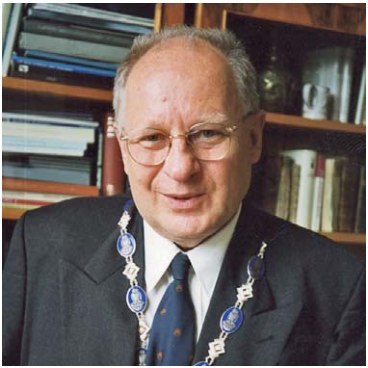
Jānis Stradiņš
1933 – 2019
- Cemetery
- Burial location pending verification
Jānis Stradiņš combined a career in chemistry with an extensive study of the history of science. He investigated how research institutions, individual scholars and wider political conditions shaped intellectual life in Latvia. That historical perspective made scientific achievement part of a broader account of the country's culture. He also became a prominent public voice during the movement to restore independence. His contributions to discussions of historical memory and national symbols connected scholarship with civic responsibility. Through leadership in the Latvian Academy of Sciences, writing and public engagement, he helped explain why the preservation of knowledge and institutions mattered. His legacy includes experimental research, historical scholarship and the example of an academic participating thoughtfully in public affairs. Born in Riga on 10 December 1933, Stradiņš was the son of the physician Pauls Stradiņš. He completed Riga Secondary School No. 5 in 1951 with a gold medal and graduated with distinction from the chemistry faculty of the Latvian State University in 1956. His teachers included Gustavs Vanags, Augusts Ķešāns and Lidija Liepiņa. In 1960 he defended a doctoral thesis at Moscow State University. These years established the chemical training on which his experimental work rested, while his systematic interest in the history of natural science had already begun during his university studies. [2] He joined the Latvian Institute of Organic Synthesis when it was founded in 1957 and worked closely with its founder, Solomon Hiller. His research examined organic molecular structures and the principles governing their electrochemical transformations. He developed methods for generating free radicals electrochemically and determining the structures of these short-lived particles, using electron spin resonance spectroscopy. Polarography also provided a means of investigating medicinal preparations. In 1968 he defended a further doctoral thesis concerning polarography and the electronic structure of nitro and carbonyl compounds, and in 1974 he became a professor of physical chemistry. [2] This experimental programme involved cooperation beyond Latvia, including work with associates of Nobel laureate J. Heyrovsky in Prague and with the Frumkin and Zelinsky institutes in Moscow. Stradiņš also held an editorial role, directing the journal Chemistry of Heterocyclic Compounds from 1975 to 1985. The chapter credits him with twenty-seven books, hundreds of research publications and many additional articles written for broader audiences. His publication record extended across physical organic chemistry, analytical chemistry and scientific history, rather than separating laboratory investigation from the communication and interpretation of knowledge. [2] As a historian, he examined Baltic research centres and the development of natural science across successive institutional and political settings. He presented Latvian scientific history as a connected process extending back to the sixteenth century. His subjects included P. Walden, W. Ostwald and T. Grothuss, and his work brought the achievements of Baltic German scientists into accounts of science in Latvia. Beginning in 1958, he organised a series of Baltic conferences on scientific history, numbering twenty-one in the chapter’s account. From 1990 he was repeatedly elected to lead the Baltic association concerned with the history and philosophy of science. [2] During the independence movement, Stradiņš introduced the designation “Third Awakening” and supplied historical arguments for Latvia’s right to statehood. He chaired the commission that presented the case for restoring the red-white-red flag, coat of arms and national anthem to the Supreme Soviet of the Latvian SSR. On 7 October 1988 he addressed the public gathering at Mežaparks held immediately before the founding congress of the Popular Front. His activity also included support for recovering historical place-names and democratising scientific life. In 1991 he helped initiate and organise the first World Congress of Latvian Scientists. [2] Elected a full member of the Latvian Academy of Sciences in 1973, he later served as vice-president from 1992 to 1998, president from 1998 to 2004, and Senate chairman from 2004. His responsibilities included seeking research funding, reorganising scientific structures and strengthening international relationships as the academy moved towards a Western institutional model. The academy awarded him its Grand Medal in 1993, and several foreign academies elected him to membership. From 2005 he supervised Lettonica, a state research programme joining work on Latvian history, language and culture. This programme continued his involvement in research spanning several disciplines. [2]
The book A Hundred Great Latvians, which includes this person, can be purchased here.
The resting place has not yet been established.
Sources & Further Reading
Books
- [2] Apinis, P. A Hundred Great Latvians. Nacionālais apgāds, Riga, 2006, pp. 158-159. ISBN 9984-26-288-X.