
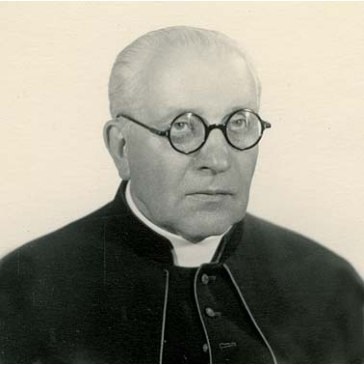
Julijans Vaivods
1895 – 1990
- Cemetery
- Aglona Basilica, Latvia
Julijans Vaivods led Catholic institutions through decades in which religious activity was constrained by Soviet power. His life included parish work, theological responsibilities, imprisonment and later service as an apostolic administrator. In 1983 he was made a cardinal. The appointment gave international visibility to the Catholic community in Latvia, particularly its strong traditions in Latgale. His work required the maintenance of clergy, worship and education under difficult political conditions. He also left writings that contribute to the record of church life. Vaivods died in 1990, at a moment when Latvia’s political future was changing rapidly. Born on 18 August 1895 in Daugavpils District, Vaivods attended schools in Vārkava and Preiļi before undertaking theological studies in Petrograd. He graduated from the Catholic Theological Seminary there in 1918 and was ordained on 7 April of that year. His early service included considerable educational work. During Latvia’s first period of independence, he taught religion in Polish, Russian and Latvian schools, while also teaching the Latgallian language on courses for prospective teachers. His responsibilities therefore reached beyond parish worship into schooling and teacher preparation. [2] Writing and translation accompanied this teaching. His first textbook, The Source of Evil, appeared in 1921, followed by Fundamental Dogmatics in 1924. He also investigated the history of Catholicism in Latvia and produced several studies, including History of the Catholic Church of Kurzeme, published in 1943. His connection with that region began with a posting in 1924. Over the following years he served congregations in Lēnas, Ciecere, Pampāļi, Vaiņode, Alsunga, Ventspils and Liepāja. In 1940 he completed further studies at the University of Latvia’s Faculty of Catholic Theology. [2] Through Soviet rule and the German occupation, Vaivods remained with his congregation and assumed responsibilities for the Liepāja diocese as a whole. He administered it for four years as general curate. Pope Pius XII recognised this service in 1949 by granting him the distinction of Prelate of Honour, although Vaivods did not learn of the award until 1963. A manuscript concerning church history later became the basis for action against him: Soviet authorities alleged that it misrepresented their political system. In 1958 he received a two-year sentence and was sent to a forced-labour camp in Mordovia, where neither a Bible nor a rosary was available to him. [2] After his release, he moved to Vaiņode in 1960. The next year he was transferred to Riga to become dean of St Jacob’s Church, and in 1962 he took responsibility for administering the Riga Metropoly. His episcopal appointment and designation as apostolic administrator followed in 1964. That year he attended the third session of the Second Vatican Council in Rome and was consecrated bishop. Pope Paul VI also involved him in the commission working on church canons and appointed him to the newly established Synod of Bishops. [2] The Riga Metropoly’s responsibilities extended to Catholic congregations elsewhere in the Soviet Union, with Lithuania excepted. During the 1960s and 1970s, Vaivods negotiated compromises between Catholic communities and the Communist authorities in Soviet Latvia. His subsequent elevation recognised both this administration and his concern for Catholics across other Soviet republics. Pope John Paul II announced his appointment on 5 January 1983, and the formal ceremony took place at the Vatican on 2 February. He was the first cardinal in the history of the Catholic Church in Latvia, and the appointment attracted attention in the international press. [2] Vaivods continued in service until his death on 24 May 1990 and was buried at the Basilica of Aglona. The burial placed him at a major centre of Catholic religious life in Latvia, particularly closely associated with Latgale. The basilica, completed in 1800, draws pilgrims from Latvia and elsewhere in Eastern Europe for its annual August observances. Alongside this place of remembrance, his textbooks and historical studies preserve another documented aspect of his work: a sustained engagement with religious education and the history of the communities he served. [2]
The book A Hundred Great Latvians, which includes this person, can be purchased here.
The map marker shows the cemetery; the exact grave position is not yet established.
Sources & Further Reading
Books
- [2] Apinis, P. A Hundred Great Latvians. Nacionālais apgāds, Riga, 2006, pp. 106-107. ISBN 9984-26-288-X.