
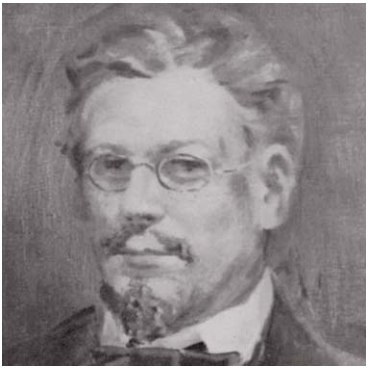
Juris Alunāns
1832 – 1864
- Cemetery
- Lielvircava Cemetery, Latvia, beside the Lutheran church
Juris Alunāns used translation to demonstrate what Latvian could become. His 1856 collection Dziesmiņas brought European poetry into Latvian and showed that the language could carry demanding literary forms. He also worked to expand its vocabulary for education and public discussion. At Dorpat he joined the circle of students associated with the Young Latvian movement. Literature, journalism and language reform were connected parts of his activity: a community needed words for new ideas as well as opportunities to read and debate them. He became involved in Pēterburgas Avīzes, although illness and censorship limited a career that ended when he was only thirty-one. His influence continued through the vocabulary, translations and example he left to later writers. Alunāns was born on 13 May 1832 into the family of the leaseholder of Jaunkalsnava Manor. His parents’ prosperous circumstances made an extensive education possible, although his childhood schooling was conducted in German. During his years in Jelgava, he acquired knowledge of German, Russian, Greek, Latin, Lithuanian, French and Hebrew, while pursuing serious study of Latvian. He read Homer, Thucydides, Plato, Sophocles and Euripides in their original language and composed verse in Greek using classical metres. His advocacy for Latvian thus developed alongside broad experience of other languages and literary traditions. [2] The public setting for his work was a society in which literacy had spread more widely than the range of available reading. By the 1850s, nearly all adult Latvians in Vidzeme and Kurzeme could read, but the chapter describes their reading material as largely confined to the Bible and calendars. More affluent Latvian students sought university education at Dorpat and brought their knowledge into efforts to inform a wider Latvian readership. Alunāns went there in 1855 to study medicine, history and national economy, entering a setting where questions of education and national culture were being discussed together. [2] That year he became acquainted with Krišjānis Valdemārs, Krišjānis Barons and Kaspars Biezbārdis. Their Latvian evenings provided occasions for discussion of national culture. Members of the student circle investigated folklore, wrote polemical contributions for newspapers and advanced their views through Mājas Viesis. Within this group, Alunāns represented a particularly radical position. His public writing was not limited to poetry or language: he published approximately 150 articles and helped develop Latvian journalism on economic questions. In 1859–1860 he also issued three volumes of the popular-science collection Sēta, daba, pasaule, whose title joins the farmstead with nature and the wider world. [2] His language programme addressed practical questions of how literary Latvian should be developed. The essay accompanying his poetry translations called for sustained work on grammar, common linguistic standards, vocabulary and spelling reform. He created around six hundred new words, while remaining willing to introduce words from other languages. Among the poets he translated were Horace, Goethe, Schiller, Pushkin, Lermontov and Heine. His Latvian adaptation of Heine’s Lorelei, entitled Laura, also entered contemporary controversy: the clergyman Brāže mocked it in terms that helped give currency to the designation “Young Latvians.” [2] The newspaper founded with Valdemārs in 1862 gave this public activity another institutional form, with Alunāns serving as its first editor-in-chief. Its satirical supplement initially appeared as Dzirkstele and was later called Zobugals. Contributors used it to criticise the Baltic German landowning class and the clergy. From January 1864, Alunāns was kept under continuous police surveillance, and many of his poems and articles were prevented from appearing. His brother Heinrihs subsequently brought these suppressed writings into print after their author’s death. [2] Alunāns died on 18 April 1864 and was buried in Lielvircava Cemetery beside the Lutheran church. Publication and adaptation continued to carry his work to readers and singers. An expanded edition of Dziesmiņas appeared in 1867, as did his book Tautas saimniecība on national economy. A poem adapted from the Czech writer František Ladislav Čelakovský acquired a further life as a hymn, with a concluding couplet supplied by Auseklis and music by Andrejs Jurjāns. In 1910 his nephew Ādolfs Alunāns published a book about his life, adding a family account to the record of his literary and public activity. [2]
The book A Hundred Great Latvians, which includes this person, can be purchased here.
The map marker shows the cemetery; the exact grave position is not yet established.
Sources & Further Reading
Books
- [2] Apinis, P. A Hundred Great Latvians. Nacionālais apgāds, Riga, 2006, pp. 18-19. ISBN 9984-26-288-X.