
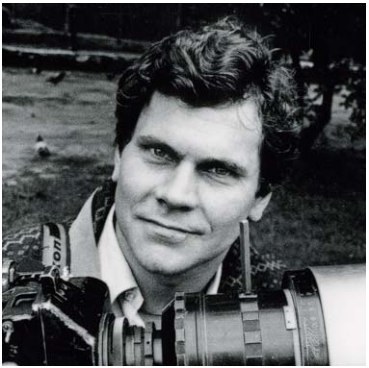
Juris Podnieks
1950 – 1992
- Cemetery
- Forest Cemetery / Meža kapi, Riga, Latvia
Juris Podnieks used documentary film to listen to people whose experiences challenged reassuring public narratives. His 1986 film Vai viegli būt jaunam? brought the concerns of young people to a wide audience and became a landmark of late Soviet documentary cinema. As political change accelerated, his filmmaking recorded the struggle for freedom in Latvia and elsewhere in the Soviet sphere. The camera became a witness to events whose outcome was still uncertain. His work combined attention to individual voices with a sense of the historical forces surrounding them. He died while diving in Zvirgzdu Lake in 1992. The films remain a valuable record of social questioning and the recovery of independence. Podnieks was born in Riga on 5 December 1950 and began working at the Riga Film Studio while still at school. His professional training proceeded alongside studio experience: he became an assistant cameraman in 1972 and graduated from the Soviet State Institute of Cinematography, known as VGIK, in 1975. He subsequently worked as a cameraman and, from 1979, as a director. This progression placed the technical responsibilities of filming before his later leadership of documentary productions, giving his career a foundation in both camera work and direction. [2] His early filmography included “Šūpulis” in 1977 and “Brāļi Kokari” in 1978, followed by “Puikas, zirgos!” in 1979 and “Baltais Ave Sol” in 1980. His first feature-length documentary, “Strēlnieku zvaigznājs,” brought recognition in 1982. Further films included “Komandieris” in 1984 and “Veļ Sīzifs akmeni” in 1985. Across his career, he received the Latvian documentary award Lielais Kristaps four times for best documentary. These productions and awards establish the substantial body of work that preceded and accompanied his better-known films of the later Soviet period. [2] The scale of the audience for his 1986 youth documentary was exceptional: within a year, twenty-eight million people had seen it in Soviet cinemas alone. It reached audiences in more than eighty countries and was also distributed internationally by satellite. Rather than centering on immediate political events, it addressed personal concerns during the period of perestroika and gave attention to people who had seldom been heard publicly. In 1987 Podnieks became the first Latvian director to receive offers of cooperation from international television organizations including Channel 4, ARTE, YLE, and NHK. [2] International production opened a wider setting for his examination of Soviet society. The five-part “Mēs?”, released in 1989 and known in English as “Hello, Do You Hear Us?”, included unrest in Uzbekistan, survivors of the Armenian earthquake, striking workers in Yaroslavl, and former inhabitants returning to Chernobyl. Its concerns extended beyond political institutions to the difficulties people might face in adjusting to freedom after totalitarian rule. The production received the Prix Italia in 1990 and a Royal Television Society Award in 1991. His filming also took him to Vilnius, Baku, Yerevan, Moscow, and the fall of the Berlin Wall. [2] For “Krustceļš,” or “Homeland,” in 1990, Podnieks incorporated material from that year’s Latvian Song Festival into an account of the Baltic countries and their efforts to recover independence. His studio recorded public support for the independence declaration at Riga’s Daugava embankment on 4 May 1990 and filmed the barricades in January 1991. During the shooting in central Riga on 20 January, two studio cameramen, Andris Slapiņš and Gvido Zvaigzne, were mortally wounded. The following film, “Pēcvārds,” or “Afterword,” continued “Homeland” and was dedicated to both men. [2] His final filmography included “Impērijas gals” in 1991 and “Klusuma stunda” in 1992. The people he filmed ranged from Sakharov and Bonner to Yeltsin, Shevardnadze, and Gorbachev, but also included sculptors, conductors, soldiers, and people affected by drug addiction. This breadth gave his record of a changing society both prominent public figures and less familiar participants. Podnieks is buried in Riga’s Meža kapi, the Forest Cemetery. His surviving films preserve encounters with individuals and events across the Soviet Union’s final decade, including the work of colleagues whose lives were lost while recording Latvia’s struggle. [2]
The book A Hundred Great Latvians, which includes this person, can be purchased here.
The map marker shows the cemetery; the exact grave position is not yet established.
Sources & Further Reading
Books
- [2] Apinis, P. A Hundred Great Latvians. Nacionālais apgāds, Riga, 2006, pp. 196-197. ISBN 9984-26-288-X.