
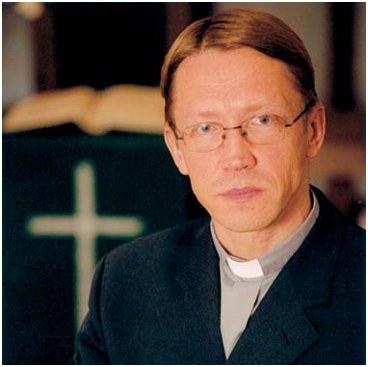
Juris Rubenis
1961 –
Juris Rubenis became a prominent religious voice during the late Soviet period and Latvia's movement toward restored independence. His pastoral work and involvement in the Rebirth and Renewal movement linked questions of faith with freedom of conscience and public responsibility. Writing offered another way to explore ethics, spiritual life and the choices people make in difficult circumstances. His later engagement with contemplation and personal development broadened the settings in which these questions were discussed. His career is therefore more than a sequence of church appointments: it follows a continuing interest in how inner conviction relates to relationships and society. Rubenis was born in Riga on 20 December 1961 and studied at the theological seminary of the Latvian Evangelical Lutheran Church. Archbishop Jānis Matulis ordained him in 1982, at a time when official Soviet atheism and ideological campaigns placed the clergy under pressure. Between 1982 and 1989 his pastoral appointments included the Lutheran congregation in Liepāja as well as service in Durbe, Ķurbe, and Garkalne. Matulis was an important authority for him, while Professor Roberts Feldmanis was among his spiritual teachers. His early ministry developed within this restricted environment for religious life. [2] Religious education became a practical area of his work before Soviet restrictions had ended. In 1987 he established a Sunday school despite the prohibition on providing religious instruction to children. Three years later, he brought together teachers of religion to develop proposals for Christian education in Latvia. The group examined experience from other countries and worked to persuade the authorities that a Christian school was needed. These initiatives addressed both the immediate task of teaching and the broader question of how religious education could be organized as Latvia’s public institutions changed. [2] During the national awakening, Rubenis worked alongside other young pastors, including Modris Plāte, whose public activity connected church circles with the independence movement. He helped establish the pastors’ Revival and Renewal movement in 1987 and joined the board of the Latvian Popular Front when it was formed in October 1988. In 1989 he began serving Riga’s Luther congregation at Torņakalns. Under his ministry it grew into the largest Latvian Lutheran congregation, attracting listeners from across Latvia. His public reputation rested in part on sermons delivered in accessible language and on his discussion of ethical and religious questions. [2] The rebuilding of theological education formed another substantial responsibility. Rubenis served as pro-rector of the church’s theological seminary in 1989–1990 and initiated the restoration of the University of Latvia’s Faculty of Theology in 1990. He invited Egils Grīslis, Visvaldis Varnesis Klīve, Juris Cālītis, and Leons Gabriels Taivans to Latvia to assist with that work. From 1990 to 1992 he was the faculty’s deputy dean, and in 1992 he received a doctorate in theology. His teaching appointments also included lecturing at the Luther Academy. [2] His writing reached beyond academic theology through collaboration with the artist Māris Subačs. Their books used short tales, reflections, symbols, and illustrations to address philosophical, religious, and ethical subjects. Titles included “Zīmējumi upē,” “Astotā diena,” and “Ceļš uz Emavu,” the last offering 365 tales for daily reflection. Their “Dīvainā karaļvalsts” was adapted by Arnis Ozols as a musical Christmas story and staged at Riga’s Daile Theatre on 19 December 2003. In 2006 Paraclete Press in the United States published Rubenis’s “The Mystery of Eden: Thoughts and Parables,” extending the international availability of his work. [2] Rubenis’s bibliography included more than five hundred publications, with articles on philosophy, theology, and ethics appearing in Western European and American periodicals. His 1997 article “What Can Unite Us Today?” was nominated for the Bonnier Prize and ranked among that year’s five best Latvian press publications. His public responsibilities included membership of cultural and religious advisory bodies, service on the Council of the Order of the Three Stars, and work as a theology expert for the Latvian Council of Science. He became an officer of the Order of the Three Stars in 1994 and an honorary member of the Latvian Academy of Sciences in 2002. [2]
The book A Hundred Great Latvians, which includes this person, can be purchased here.
Sources & Further Reading
Books
- [2] Apinis, P. A Hundred Great Latvians. Nacionālais apgāds, Riga, 2006, pp. 206-207. ISBN 9984-26-288-X.
Web resources
- [1] Juris Rubenis