
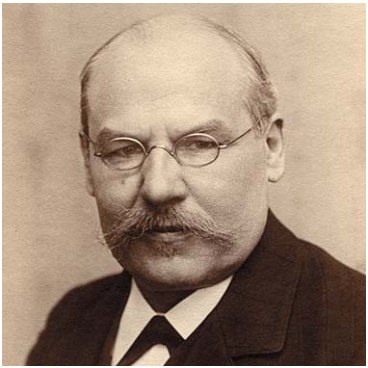
Kārlis Mīlenbahs
1853 – 1916
- Cemetery
- Great Cemetery / Lielie kapi, Riga, Latvia
Kārlis Mīlenbahs made the systematic study of Latvian a central intellectual project. A teacher as well as a linguist, he collected words and examined how the language was actually spoken and written. His work connected everyday usage with the demanding task of building reliable reference tools. The dictionary associated with his name was developed further after his death by Jānis Endzelīns and other contributors. It became a major resource for the study of Latvian vocabulary and dialects. Mīlenbahs also wrote on grammar, literature and translation, helping establish a professional conversation about language. His legacy is therefore collaborative as well as personal: material assembled over many years became the foundation for work completed by successors. Displaced during the First World War, he died in Võru in Estonia and was buried in Riga. Born in Kandava parish on 18 January 1853, Mīlenbahs completed his studies in classical philology at the University of Dorpat, now Tartu, in 1880. His knowledge extended across several languages, and his teaching appointments took him to Talsi and Riga as well as Dorpat and Võru. During his university years he translated Homer’s Odyssey into Latvian. Classical scholarship thus formed an early part of a career that would also encompass Latvian vocabulary, sentence structure, spelling, folklore and questions about language more generally. [2] An important starting point for his lexicographical work was the Latvian–German dictionary published by the clergyman Carl Christian Ulmann in 1872. Mīlenbahs initially enlarged this existing reference work by adding blank leaves on which he recorded omitted vocabulary and observations. The growing collection eventually exceeded what could be accommodated in two copies of the book. He then commissioned a cabinet and transferred the material to individual paper slips, assigning each word its own record. In time, three cabinets were needed to hold the collection. [2] The search for vocabulary extended well beyond his own reading and notes. Mīlenbahs asked collaborators in different Latvian regions to supply words absent from Ulmann’s dictionary. In 1900 he and Jānis Endzelīns began travelling to investigate regional speech. Their fieldwork provided material both for the dictionary and for the Latvian grammar subsequently written by Endzelīns. This regional evidence was significant in a language with three principal dialects and numerous local varieties, whose literary standard rested on the middle dialect. [2] His grammatical research examined the organisation of Latvian sentences, including their characteristic patterns and word order, in comparison with other Indo-European languages. Working with Endzelīns, he also developed spelling principles based on Latin letters with diacritical signs, replacing the earlier use of Gothic lettering. These principles were adopted in 1908 and received official confirmation from the Latvian state in 1919. His broader linguistic interests included the beginnings of language and theories concerning the emergence of articulated human speech, subjects that placed Latvian research within a wider field of enquiry. [2] Mīlenbahs produced approximately one hundred scholarly works, with literature and folklore among the subjects he addressed. He also introduced derived forms and borrowed vocabulary that entered written and spoken Latvian. His work followed research by German scholars including Adalbert Bezzenberger, August Bielenstein and Ulmann, while establishing a professional Latvian role in the study of the language. Alongside his investigations of speech and grammar, translation remained another documented strand of his activity, with the Odyssey standing out among his contributions. [2] When Endzelīns returned to Riga in 1920, he resumed preparation of the dictionary. The resulting six-volume work contained approximately 110,000 words, drawing on literary writing, folklore, newspapers and local speech. Latvian headwords were accompanied by German explanations, while entries also provided translations, pronunciation information, intonation marks and discussion of possible word origins. The chapter identifies it as the most comprehensive Latvian dictionary available at the time of writing. A further public recognition of Mīlenbahs’s contribution came in 2003, which Latvia designated as a year devoted to his memory. [2]
The book A Hundred Great Latvians, which includes this person, can be purchased here.
The map marker shows the cemetery; the exact grave position is not yet established.
Sources & Further Reading
Books
- [2] Apinis, P. A Hundred Great Latvians. Nacionālais apgāds, Riga, 2006, pp. 34-35. ISBN 9984-26-288-X.