
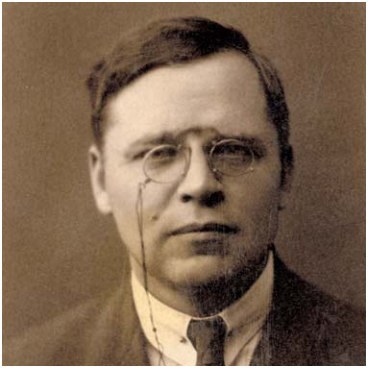
Kārlis Skalbe
1879 – 1945
- Cemetery
- Current burial location requires confirmation; place of death in Stockholm is not sufficient for a grave pin
Kārlis Skalbe brought ethical questions into short literary tales whose apparent simplicity gives them lasting force. His writing explores kindness, power, suffering and the consequences of human choices. Poetry and journalism formed further parts of his work. He participated in the political struggles of his time, experienced exile after the 1905 Revolution, and later served in the institutions of independent Latvia. Literary creation and public commitment were closely connected throughout his life. The Second World War displaced him again, this time to Sweden, where he died in 1945. Born in Vecpiebalga on 7 November 1879, Skalbe qualified as an elementary-school teacher by passing the required examinations while employed as a clerk in Rauna and Riga. In 1901 he was teaching in Ērgļi, where he formed friendships with Rūdolfs Blaumanis and other writers and established a literary circle. The authorities regarded his activities as evidence of political unreliability, and he lost his teaching position before the 1905 Revolution. His poetry of this period set aspiration against ordinary reality and expressed opposition to commercial self-interest and arbitrary power. [2] In 1905 Skalbe attended the Latvian Teachers’ Congress in Riga and served in the central bureau of the Latvian Union of People’s Teachers. He also signed the Decadent Manifesto. The magazine Kāvi, which he founded and edited, published editorials sympathetic to the revolution; it was subsequently suppressed, and proceedings were opened against him. He left Latvia in 1906, travelling through Finland to Switzerland and moving to Norway the following year. After returning in 1909, he was arrested late in 1911 and remained imprisoned until early 1913. [2] Prison became a setting for both translation and original prose. Skalbe translated works by Oscar Wilde and Alexander Pushkin and wrote literary fairy tales. These stories rejected hatred and violence while giving particular weight to spiritual strength. The 1913 tale Pussy’s Water Mill became especially well known; A Tale of the Farthing, The Giant and Hangman’s Daughter also entered the recognised body of Latvian literary classics. His imaginative prose developed alongside a substantial poetic output rather than replacing it, and subsequent verse collections addressed the destruction of his homeland and the struggle for Latvian liberation. [2] At the beginning of the First World War, Skalbe worked as a journalist in Warsaw and Moscow. In 1916 he joined a Latvian Rifle Battalion. His advocacy of an independent state led to membership of the Latvian Provisional National Council in 1918, and he helped prepare foundational state documents. After independence, he served in the Constituent Assembly and in two successive Saeimas, while remaining active in societies, congresses and newspapers. He was also known as a public speaker and an opponent of Communist ideas. The dedication on Riga’s Freedom Monument, expressing commitment to homeland and liberty, was adopted at his suggestion. [2] Following the Soviet occupation in 1940, Skalbe withdrew from literary and public activity and did not cooperate with the occupying regime. Under the subsequent German occupation, he oversaw Latvju Mēnešraksts, a monthly journal in which he continued to uphold Latvian independence and opposition to both occupying powers. His departure in 1944 was by boat from Jūrkalne across the Baltic Sea. He died in a Stockholm hospital on 15 April 1945, and the urn containing his ashes was initially placed in the columbarium at Högalidkyrkan. [2] Saulrieti, his summer home near Vecpiebalga, became the principal setting for his commemoration in Latvia. Skalbe and his family spent eighteen summers there between 1926 and 1944. The house, on Incēni Hill overlooking Lake Alauksta, opened as a memorial museum in 1984, with its interior preserved as it had been during his lifetime. On 20 June 1992 his ashes were brought back for burial nearby. The urns of the poet, his wife and his daughter rest on Vaktskalns Hill opposite the house, linking the memorial landscape with the family’s former summer residence. [2]
The book A Hundred Great Latvians, which includes this person, can be purchased here.
The resting place has not yet been established.
Sources & Further Reading
Books
- [2] Apinis, P. A Hundred Great Latvians. Nacionālais apgāds, Riga, 2006, pp. 80-81. ISBN 9984-26-288-X.
Web resources
- [1] Kārlis Skalbe