
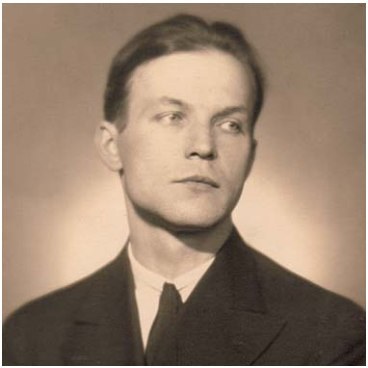
Kārlis Zemdega
1894 – 1963
- Cemetery
- Rainis Cemetery / Raiņa kapi, Riga, Latvia
Kārlis Zemdega worked in monumental, memorial and portrait sculpture. His figures often use simplified form and carefully controlled gesture to express ideas of endurance, grief or aspiration. Stone was especially important to his artistic language. Born Kārlis Baumanis, he adopted the name by which he became widely known during his professional career. His monuments appeared in different parts of Latvia, making sculpture part of local as well as national remembrance. Some works were destroyed or altered under occupation and later restored, so the history of an object may extend well beyond the artist’s lifetime. He also taught younger sculptors. Zemdega died in Riga in 1963 and was buried at Rainis Cemetery. Zemdega was born on 7 April 1894 in the Aizpute district. His education ranged across the visual arts and the humanities: he attended V. Blum’s school in Riga and an art school in Vilnius, and studied in the University of Latvia’s philology and philosophy faculty. At the Art Academy of Latvia he trained in painting with J. R. Tillbergs and in sculpture with K. Rončevskis, graduating in 1927. He also studied with B. Dzenis. Additional experience in workshops and academic institutions took him to several European countries and to Egypt. [2] In 1928 he began carving stone, which became central to a practice encompassing freestanding figures, reliefs and large commemorative compositions. He used granite, marble and labradorite, with bronze appearing less frequently. Classical sculpture provided an important point of reference, but his treatment connected that inheritance with Latvian cultural subjects. Architectural organisation mattered alongside the individual figure: masses and poses were arranged within a coherent structural whole. His work could be heroic in character or more intimate and lyrical, while its stylisation reduced detail in favour of clearly established forms. [2] The 1930s brought sustained activity across these different fields. Zemdega exhibited figurative pieces, entered competitions for monuments, produced memorial sculpture and designed decorative work for buildings. His commemorations of those killed in the First World War and Latvia’s War of Liberation were erected in Viļaka, Rauna, Džūkste, Rūjiena and Dobele. At Rauna, the monument known as Kokle, dating from 1933, used the name of a Latvian stringed instrument. In Rūjiena, the Tālava Trumpeter was unveiled on 15 August 1937 to commemorate the area’s liberation and the people who had fallen in that struggle. [2] A different Rūjiena memorial joined his public work to the remembrance of an individual life. Madonna orans, sculpted in 1934 and unveiled on 5 July 1936, honoured Jūlija Skujiņa, a parish-school teacher who had drowned in the River Rūja at twenty-four. The poet Rainis was another enduring subject. Zemdega attended his funeral in 1929 and subsequently devoted considerable time to developing a grave memorial that drew on the poet’s writing. Completed in 1934, it presented a youthful figure emerging into wakefulness, carved from polished red granite from Finland. [2] The Rainis memorial, associated with architect Pēteris Ārends, gave sculptural form to spiritual strength, continuing struggle and the arrival of light. Zemdega later designed a further monument to the poet for Riga’s Esplanāde. His pupils Aivars Gulbis and Laimonis Blumbergs executed that design in stone, and it was unveiled in 1965, after his death. Alongside these major projects, he made portraits of prominent people. The range from portraits to public monuments formed part of a career that also included educating sculptors as a professor at the Art Academy of Latvia. [2] Political intervention affected both his professional position and the survival of his work. Soviet ideological objections led to his removal from the Academy, while the authorities ordered many of his monuments dismantled during the 1950s and 1960s. The Tālava Trumpeter survived the occupation years through the efforts of Rūjiena sculptor Jānis Zariņš. Other aspects of Zemdega’s legacy remained visible in the work of his pupils and in the protected cultural status attained by sculptures in different Latvian localities. The posthumous completion of the Esplanāde monument extended the public presence of his designs beyond his lifetime. [2]
The book A Hundred Great Latvians, which includes this person, can be purchased here.
The map marker shows the cemetery; the exact grave position is not yet established.
Sources & Further Reading
Books
- [2] Apinis, P. A Hundred Great Latvians. Nacionālais apgāds, Riga, 2006, pp. 102-103. ISBN 9984-26-288-X.
Web resources
- [1] Kārlis Zemdega