
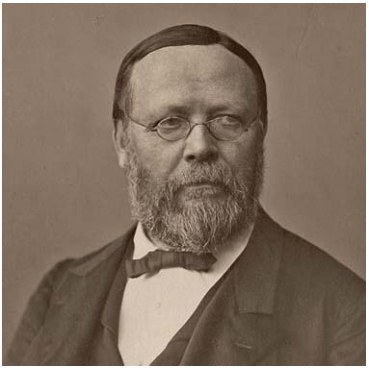
Krišjānis Valdemārs
1825 – 1891
- Cemetery
- Great Cemetery / Lielie kapi, Riga, Latvia
For Krišjānis Valdemārs, cultural confidence and economic opportunity belonged together. A leading participant in the Young Latvian movement, he challenged the assumption that education required Latvians to abandon their language or identity. His work as a journalist and organiser helped bring these arguments into public debate. Valdemārs studied economics at Dorpat, now Tartu, and later worked in St Petersburg and Moscow. He supported Pēterburgas Avīzes and encouraged practical education, particularly training for seafaring. Maritime schools offered coastal families a route into skilled employment and participation in international trade. His legacy therefore includes both the language of national self-respect and institutions that could improve everyday prospects. He died in Moscow; his remains were brought to Riga for burial. Valdemārs was born on 2 December 1825 at the Vecjunkuri farmstead in Ārlava parish, in the Talsi district. He could read by the age of five and attended local schools, but his further education followed a longer path. In 1848 he organised an intellectual discussion group and a public library at Ēdole. With assistance from Alexander Suvorov, Governor General of the Baltic Provinces, he entered the higher district school in Liepāja at twenty-four. He completed his studies there in 1854, the same year that he entered university. [2] While still at school, he compiled a volume containing three hundred stories, humorous tales and riddles. Its introduction explained that he wanted to encourage reading and strengthen peasants’ self-esteem. At Dorpat he began contributing to Latvian and German newspapers and brought Latvian students together in 1855. On his thirtieth birthday, he placed a card on his room identifying himself as Latvian. In a society where Latvian identity was commonly associated with peasant status and advancement often required assimilation into German circles, this was a public assertion that education and Latvian identity could coexist. [2] After graduating in 1858, Valdemārs entered government service in St Petersburg and became an assistant editor of St Petersburger Zeitung, published by the city’s Academy of Sciences. His political proposals addressed material conditions as well as education. In 1861 he submitted a reform programme to the tsar covering land and schooling in Vidzeme and Kurzeme. Two years later he helped establish the St Petersburg Latvian Reading Society, the first legally constituted Young Latvian organisation. Following his move to Moscow in 1867, he continued informing the imperial government about Baltic noble privileges and proposing improvements in the circumstances of Latvians. [2] Ainaži became an important site for putting his maritime proposals into practice. With the support of Grand Duke Constantine, the tsar’s brother, Valdemārs founded a school there in 1864 that admitted ordinary people; Christian Dahl was its first head. Valdemārs also helped secure imperial legislation governing maritime schools. Under that law, forty-one schools opened along the coasts of the Russian Empire between 1867 and 1893, including ten on the Latvian coast. The schools’ general educational level corresponded to that of elementary schools supervised by the Ministry of People’s Education. The Ainaži institution later became a museum with a substantial display devoted to him. [2] His economic arguments rested on the study of statistics. He advocated a market economy and urged Latvians to build wealth, increase earnings, use credit and compete freely. Much of his writing in Russian and German concerned agriculture and disputes with the Baltic gentry. For Latvian readers, he addressed seafaring, natural science, economic questions and education, while also editing dictionaries. As a correspondent for Moskovskiye Vedomosti, he exercised influence in arguments over noble privileges. He also opposed proposals by imperial officials to introduce a Slavic alphabet for written Latvian. [2] His organisational work reached into cultural institutions beyond the press and maritime schools. He contributed to the establishment of the Riga Latvian Society and the organisation of the first All-Latvian Song Festival, and encouraged Kaspars Biezbārdis and Krišjānis Barons to collect folklore. Valdemārs died on 7 December 1891; the Riga Latvian Society arranged his interment in Lielie kapi. Later commemorations included the renaming of Sasmaka as Valdemārpils and a sculpture by Miervaldis Polis in Ventspils. These memorials stand alongside the museum at Ainaži as documented forms of remembrance of his public and educational work. [2]
The book A Hundred Great Latvians, which includes this person, can be purchased here.
The map marker shows the cemetery; the exact grave position is not yet established.
Sources & Further Reading
Books
- [2] Apinis, P. A Hundred Great Latvians. Nacionālais apgāds, Riga, 2006, pp. 16-17. ISBN 9984-26-288-X.