
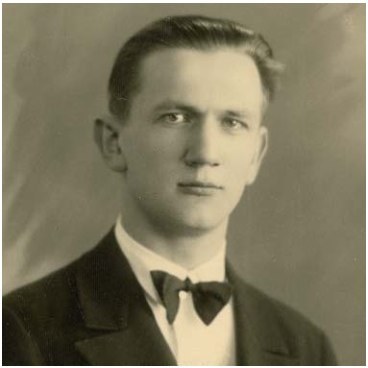
Leonīds Vīgners
– 2001
- Cemetery
- Forest Cemetery / Meža kapi, Riga, Latvia
Leonīds Vīgners worked across opera, orchestral and choral music. His career combined performance with teaching and the organisation of ensembles, placing him within several of Latvia’s major musical institutions. He came from a family with strong musical traditions and developed a notably demanding approach to preparation. His work helped sustain professional music through periods of severe political change. Recordings, programmes and the memories of pupils provide different kinds of evidence for that contribution. The year is retained here, with the precise date held for review. This avoids turning a source discrepancy into an apparently certain database value. Vīgners was born in Moscow on 9 November 1906 and began conducting as a child. His father, Ernests, had studied at the Moscow Conservatory and later founded the Riga Institute of Phonology, where Leonīds would teach. At the Latvian Conservatory, Leonīds completed P. P. Jozuus’s organ class in 1928 and Jāzeps Vītols’s composition class in 1930. He also studied conducting and played piano and percussion. Further preparation included a conducting master course in Switzerland and periods of study in Prague, Vienna, Berlin, Dresden, Paris and Salzburg. [2] His early activities included directing the male choir Dziedonis and establishing orchestras and choirs. In 1936 he joined the Latvian National Opera as a conductor’s assistant. Between 1937 and 1939 he assisted principal conductor Leo Blech, then served as conductor from 1939 to 1944 and principal conductor from 1944 to 1949. His productions included Aida, La Traviata, The Queen of Spades, Eugene Onegin and Baņuta, and he trained younger opera soloists. Disputes with Soviet cultural authorities included his refusal to alter repertoire and supply demanded happy endings. These conflicts led to his departure from the theatre. [2] Orchestral leadership subsequently occupied a major part of his professional life. He directed the Latvian SSR Radio and Television Symphony Orchestra during 1949–1963 and again during 1967–1975. Its repertoire under him included Bach, Mozart, Beethoven, Berlioz and Wagner, alongside Russian and Latvian composers. He conducted first performances of works by Jānis Ivanovs, Lūcija Garūta, Marģeris Zariņš, Pēteris Dambis and others. Guest engagements took him to cities including Moscow, Berlin, Sofia, Tallinn, Vilnius and Tbilisi. In Riga he worked with visiting soloists such as David Oistrakh and Emil Gilels. [2] Teaching developed alongside these appointments. Vīgners joined the Jāzeps Vītols State Conservatory of Latvia in 1947 and became a professor in 1961. He founded and directed a student symphony orchestra that performed both in Latvia and abroad. Over approximately fifty years, his pupils included conductors, singers and instrumentalists. His choral work likewise involved musicians at different stages of professional life. Among the ensembles he led was a two-hundred-member choir composed of music teachers and choir conductors. This work connected his own performing career with the training and collective practice of other Latvian musicians. [2] The Song Festivals gave his conducting a wider public setting. He took part in the 1948 festival, held three years after the war, and remained involved as a principal or honorary conductor through the end of his life. At the centenary celebration in 1973, more than twenty thousand singers performed before an audience of 110,000. Soviet officials had omitted familiar folk songs and classical Latvian choral pieces from the approved programme. In the final part of the concert, however, the choirs sang such works under Vīgners and other conductors. Audience members joined in, and the event continued beyond midnight. [2] Recognition in his later years included honorary membership of the Latvian Academy of Sciences in 1993, the Order of the Three Stars in 1994 and the Great Music Award in 1998. At the 2001 festival celebrating Riga’s eight-hundredth anniversary, singers and listeners rose when he arrived in a wheelchair. He died in Riga in 2001 and was buried in Meža kapi. The family’s musical work continued through his son Ivars, a composer and musician associated with Latvian radio and television whose output included music for theatre, films and children. [2]
The book A Hundred Great Latvians, which includes this person, can be purchased here.
The map marker shows the cemetery; the exact grave position is not yet established.
Sources & Further Reading
Books
- [2] Apinis, P. A Hundred Great Latvians. Nacionālais apgāds, Riga, 2006, pp. 128-129. ISBN 9984-26-288-X.