
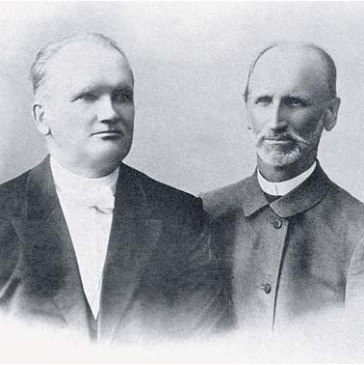
Matīss Kaudzīte
1848 – 1926
- Cemetery
- Burial location requires confirmation; do not infer a grave from the Kalna Kaibēni house museum
Matīss Kaudzīte was a teacher, writer and cultural organiser whose partnership with his brother Reinis produced Mērnieku laiki. Published in 1879, the novel made the social changes of the Latvian countryside the subject of an ambitious work of fiction. Its characters and conflicts continued to influence later literature and popular culture. Matīss also wrote independently and contributed to literary and musical life in Vecpiebalga. His involvement in education and cultural societies connected books to the communities that read them. Kalna Kaibēni preserves an important setting associated with the brothers’ literary lives. Born on 18 August 1848 at the Madari farmstead in Vecpiebalga, Matīss attended the local parish school and passed the examinations required to become a tutor. His teaching career began at Kalna Kaibēni Parish School in 1868 and continued until his retirement in 1911. The school occupied the brothers’ home: Reinis had acquired management rights to the farmstead in 1867 and later purchased it. When the parish established the school there, Matīss became its teacher and his elder brother his assistant. Their household thus served as both a place of instruction and a centre of literary work. [2] The brothers composed Mērnieku laiki between 2 September 1876 and 18 March 1879. Its subject was the resurveying of peasant holdings and the drawing of new boundaries in the Piebalga countryside around 1870. Working from a planned plot, they organised scenes of rural life around characters whose conduct could not be reduced to a simple division between virtue and wrongdoing. One organising distinction concerned the relationship between professions of faith and actual deeds. The novel appeared when Latvian readers still had little access in their own language to major examples of the genre from abroad. [2] Its significance lay especially in its characterisation. Figures such as Švauksts and Pietuka Krustiņš became recognisable reference points well beyond the parish communities the brothers knew. Literary critics regarded the book as foundational to Latvian realism because its people differed substantially from those of earlier prose and drama. Matīss’s subsequent output extended across poetry, prose and journalism, although none of his other works attained the same popularity. After Reinis’s death, he wrote Jaunie Mērnieku laiki, whose sharp treatment of Latvia’s Bolshevik government of 1919 drew condemnation from Soviet critics; the book was banned. [2] Matīss also contributed through criticism, translation and recollection. He translated or adapted works by Heinrich Heine, Garlieb Merkel, Friedrich Schiller, Mikhail Lermontov and Alexander Pushkin. His Atmiņas par tautisko laikmetu recorded memories of leading figures in nineteenth-century Latvian literature and culture and became, for some individuals, the only surviving source of information. His writings preserved opinions expressed by Reinis as well as his own. Beyond publication, the brothers hosted local intellectuals for gatherings devoted to discussion, reading and contributions to newspapers, connecting their household to wider cultural debate. [2] Travel supplied material for further books and press articles. Setting out from Piebalga, the brothers undertook journeys on foot through Central Europe; their destinations eventually ranged from Sicily to Finland. In 1889 they visited Paris, including the World Exposition and the Eiffel Tower. At home, Matīss participated in the Riga Latvian Society from its foundation and established a music society in Vecpiebalga. The brothers also helped found a savings-and-loan society. These activities placed literary work alongside practical participation in local institutions rather than confining it to the writing desk. [2] Gardening was another sustained interest. Matīss planted trees near the school and encouraged householders to plant around their homes, an example followed more widely in central Vidzeme. He arranged an arboretum in his garden and wrote Brūklenājs there. Later, finding that trees too close to the school were contributing to roof decay, he cut down the nearest ones himself. His long friendship with Elīza Rātmindere, begun when they were eighteen, led to marriage at forty-five after earlier opposition from her mother. They had no descendants. Matīss died at Kalna Kaibēni on 8 November 1926. [2]
The book A Hundred Great Latvians, which includes this person, can be purchased here.
The resting place has not yet been established.
Sources & Further Reading
Books
- [2] Apinis, P. A Hundred Great Latvians. Nacionālais apgāds, Riga, 2006, pp. 24-25. ISBN 9984-26-288-X.