
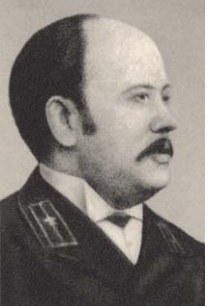
Mikhail Eisenstein
– 1920
- Kapsēta
- Russian Orthodox Cemetery, Berlin-Tegel, Germany
Mikhail Eisenstein designed some of Riga’s most visually elaborate Art Nouveau buildings. Their façades combine sculptural figures, masks, ornament and strong contrasts of surface, contributing to the streetscapes for which the city is widely known. He worked as an engineer and architect within the institutions of the Russian Empire. His buildings belong to the rapid expansion of Riga around the turn of the twentieth century, when new housing offered opportunities for architectural display. His son Sergei followed a very different artistic path in cinema. Keeping their profiles separate avoids attributing the father’s buildings to the filmmaker. Mikhail left the region after the revolution and died in Berlin in 1920. Born in St Petersburg on 17 September 1867, Eisenstein came from a family of German Jewish descent. He completed his training at the city’s Institute of Civil Engineering in 1893. Several important changes followed in 1897: he converted to Russian Orthodoxy, married Yuliya Konetskaya, whose father was a wealthy merchant, and settled in Riga. Their only son, Sergei, was born there on 23 January 1898. These dates place his professional education before the move to the city in which his principal architectural work would take shape. [2] His official responsibilities extended beyond the design of individual buildings. In 1900 he became head of the Transportation Department of Vidzeme Province, with responsibility for the maintenance of existing roads and proposals for new ones. His architectural activity consequently belonged to a career that also involved provincial infrastructure administration. At the time, Riga was the Russian Empire’s largest port city. Industrial development brought new factories and an expanding workforce, while residential construction became a substantial part of its transformation. The chapter records an increase of roughly one third in the number of residential buildings at the beginning of the century, with Art Nouveau predominating among the additions. [2] Eisenstein’s principal group of decorative Art Nouveau designs dates from 1901 to 1906. The chapter identifies seven notable buildings from those years and thirteen buildings across his output as a whole. Five stand on Alberta Street or nearby in Elizabetes and Strēlnieku streets, creating a concentrated group within the city. Their reception has not been uniform. Visitors have admired their elaborate appearance, while architects have also criticised the extent of their ornamentation. His attraction to the imagery and symbolism of Art Nouveau was expressed especially through sculpture and decorative detail, features central both to their appeal and to the reservations they have prompted. [2] Two buildings illustrate particular aspects of that work and its subsequent history. At Strēlnieku Street 4a, he designed a school building that later became the Stockholm School of Economics in Riga. Its exterior combines traditional historical forms with Art Nouveau decoration. The building at Alberta Street 2a includes an extra level serving a decorative rather than a practical purpose. Its interiors also contained elaborate designs on ceilings and floors. During Soviet occupation, the conversion of spacious apartments into communal accommodation, sometimes housing six to eight families in a single apartment, was accompanied by considerable damage to those interior features. [2] The political division within his family became explicit in 1917. Eisenstein entered White Guard service as an engineer, whereas Sergei supported the revolutionaries, serving first in a volunteer militia and later in the Red Army. The father opposed the Bolshevik regime and would not cooperate with it. His eventual departure for Germany followed that allegiance. His grave is in Berlin’s Orthodox cemetery at Tegel, a separate place of remembrance from the Riga buildings through which his work remains publicly visible. [2] The later uses and reception of those buildings form a documented architectural legacy. The school on Strēlnieku Street acquired a new educational role, while Alberta Street became a destination for visitors interested in Riga’s architecture. The close grouping of his designs allows several examples to be encountered within the same neighbourhood. Their continued attraction does not erase the critical debate about decorative excess: both the admiration and the objections belong to the recorded history of his contribution to Riga. [2]
Grāmatu “100 Latvijas personību”, kurā iekļauta arī šī personība, var iegādāties šeit.
The map marker shows the cemetery; the exact grave position is not yet established.
Sources & Further Reading
Books
- [2] Apinis, P. A Hundred Great Latvians. Nacionālais apgāds, Riga, 2006, pp. 114-115. ISBN 9984-26-288-X.