
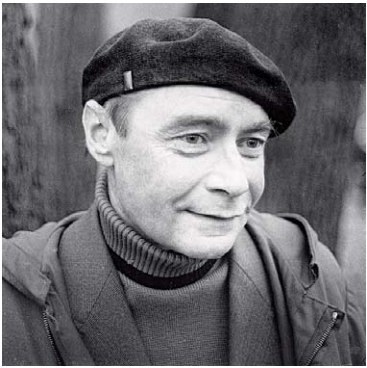
Ojārs Vācietis
1933 – 1983
- Cemetery
- Carnikava Cemetery, Latvia
Ojārs Vācietis wrote poetry of unusual emotional intensity, moving between intimate observation and questions about society, conscience and power. His career unfolded within Soviet Latvia, where official recognition did not remove the tensions between a writer's convictions and the limits imposed on public expression. His work included poems for children as well as demanding writing for adults. The range matters: playfulness, anxiety, affection and protest all belonged to his poetic voice. His relationship with Soviet ideals changed over time and cannot be reduced to a single label. Reading his poems in their historical setting reveals an artist repeatedly testing what language could say about the world around him. He died in 1983 and was buried in Carnikava. Born on 13 November 1933 in Valka District, Vācietis attended Trapene Primary School and then Gaujiena High School. His poems began appearing in local and central newspapers in 1950, before he entered university. Between 1952 and 1957 he studied Latvian language and literature in the Faculty of Philology at the Latvian State University. His employment included editorial work for magazines aimed at children and young people, as well as work at the Riga Film Studio. Literary publication, study and participation in cultural institutions thus overlapped during his early career. [2] His political commitments brought substantial contradictions. He had been active in the Young Communist League and became a Communist Party member, but in 1956 he learned of communist crimes in Hungary. In 1962 official critics accused him of presenting a distorted picture of Soviet life. Following that attack, he withdrew into a restricted circle of acquaintances, while his poetry developed a more philosophical character. Censorship prevented the publication of a substantial portion of his writing during his lifetime, so the work available to contemporary readers did not represent everything he had written. [2] Recognition increased markedly with Breath in 1966, which became a bestseller. A succession of collections followed: Cuckoo Time in 1968, Beyond the Hundredth Thirst in 1969, and both Black Coal and Piano Concert in 1971. Later books included Hours of Different Length in 1974, Gamma in 1976, The Spelling of Lightning in 1980 and C-minor in 1982. His books reached circulations numbering in the hundreds of thousands during the Soviet period. The early-1960s poem To the Voice a Cappella joined an attachment to Latvia’s natural world with concern for the country’s future, drawing on the recurring importance of birthplace and homeland in his writing. [2] His published work also extended into prose, criticism and translation. Through the Eyes of My Green Days, issued in 1959, portrayed secondary-school life in the late 1940s and provides a literary account of post-war Vidzeme. With an Owl’s Quill, published in 1983, collected journalistic writing, essays and critical reviews. In 1979 he translated Mikhail Bulgakov’s The Master and Margarita; his translations also included works by Attila József, Mikhail Isakovsky and other authors. These activities accompanied, rather than replaced, the sustained production of poetry that remained central to his working life. [2] He habitually rose early to write before the rest of his household was awake, producing a body of work extending to ten volumes. His children’s verse used humour, unexpected turns and absurdity in ways close to children’s perceptions. Such poems entered performances, songs and seasonal celebrations. More broadly, musical settings of his verse became an established part of Latvian cultural life, performed by prominent artists. The chapter describes his rejection of half-hearted effort and amateurishness as characteristic of his demanding outlook on both life and creative work. [2] Posthumous publications widened access to aspects of his writing that readers had not previously encountered. Fatality, published in 1985, brought together late poems marked by heightened tragic feeling. Ex libris appeared in 1988, including work written between the 1960s and the 1980s that censorship had kept from publication. Those poems sharply rejected totalitarian violence and duplicity. A collection of drawings, Between Poems, followed in 1993. These later volumes added to the published record beyond the books through which he had achieved recognition during his lifetime. [2]
The book A Hundred Great Latvians, which includes this person, can be purchased here.
The map marker shows the cemetery; the exact grave position is not yet established.
Sources & Further Reading
Books
- [2] Apinis, P. A Hundred Great Latvians. Nacionālais apgāds, Riga, 2006, pp. 156-157. ISBN 9984-26-288-X.
Web resources
- [1] Ojārs Vācietis