
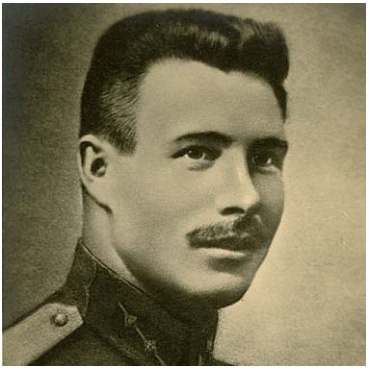
Oskars Kalpaks
1882 – 1919
- Cemetery
- Visagala Cemetery, Latvia; reburied from Liepāja in September 1919
Oskars Kalpaks became an early commander of the Latvian forces supporting the provisional government during the struggle for independence. His previous service in the Imperial Russian Army had given him practical experience of command and combat during the First World War. The forces available to the new republic were small and operated in a confused military situation. Kalpaks’ importance lies in helping organise and lead them at this vulnerable stage. He was killed in a mistaken engagement with allied German forces near Airītes on 6 March 1919. His original burial in Liepāja was followed by reburial at Visagala later that year. Airītes is an associated memorial site, not a substitute for his burial location. Kalpaks was born on 6 January 1882 at Liepsalas farmstead near Meirāni. He attended the Ministry School in Lubāna, where he also learned the violin. His military career began in 1903 with service in Warsaw. He subsequently studied at the Irkutsk War College, graduating with distinction in 1908. During his studies he received a medal recognising diligence, the first of the awards recorded in the chapter. This period of formal training preceded the combat responsibilities that would occupy him during the European war. [2] In August 1914 he commanded a machine-gun platoon on the Russian–Austrian front in Galicia. Although wounded in heavy fighting, he stayed with his unit and later received the fourth class of the Order of St Anna. Further service near the San River, around Cracow and in the Carpathians brought three decorations for courage and initiative during 1914–1915. In August 1915 his unit held its position for several hours north of Brest-Litovsk while an entire division withdrew. His conduct in that action earned him the Sword of St George. [2] Another distinction followed fighting on the Serwecz River in the Minsk region in September 1915. His unit penetrated German trenches during a surprise counterattack, and he received the fourth class of the Order of St George. The chapter emphasises that the St George awards required a specific council’s approval and recognised exceptional bravery involving serious personal danger. In September 1917 he was promoted to lieutenant-colonel. He supported Russia’s February Revolution but rejected Bolshevik politics, regarding the October Revolution as having ended his obligation under his military oath. He left the Russian Army in 1918. [2] After returning to Latvia that autumn, he began organising a Latvian military unit on 11 December. On 31 December he took command of the Separate Latvian Battalion, which consisted of three companies and operated under the headquarters of the Baltic Landeswehr. Its early actions against the Red Army helped protect the provisional government’s withdrawal, first to Jelgava and then to Liepāja. The chapter records only 220 soldiers retreating from Riga towards Jelgava under his command in January 1919, indicating the limited strength available at this stage of the independence struggle. [2] Rüdiger Graf von der Goltz reached Liepāja on 1 February and assumed command of the combined forces in Kurzeme. An offensive against the Red Army began across the front in early March. During an attempt to intercept the retreating communist forces, Kalpaks’ battalion encountered Captain von Borch’s battalion of the Iron Division. The fatal engagement also claimed Captain N. Grundmanis, commander of the Separate Student Company; Senior Lieutenant P. Krievs of the Separate Cavalry Unit; and Hans Johann Schrinder, a German artillery lieutenant attached to Kalpaks’ force. The losses therefore extended across several elements of the small formation. [2] Public commemoration began immediately, with the provisional government declaring two weeks of mourning. The initial funeral took place on 11 March, and Latvian officers subsequently gathered at that first grave to remember him. He received all three classes of the Lāčplēsis Military Order posthumously. At his final resting place in Visagala, a monument by Kārlis Zāle was unveiled in 1927, depicting an ancient Latvian warrior in granite. A museum and memorial area were also established at Airītes. These distinct sites preserve the history of his death and his burial, while the national forces continued to expand after his brief command. [2]
The book A Hundred Great Latvians, which includes this person, can be purchased here.
The map marker shows the cemetery; the exact grave position is not yet established.
Sources & Further Reading
Books
- [2] Apinis, P. A Hundred Great Latvians. Nacionālais apgāds, Riga, 2006, pp. 84-85. ISBN 9984-26-288-X.
Web resources
- [1] Oskars Kalpaks