
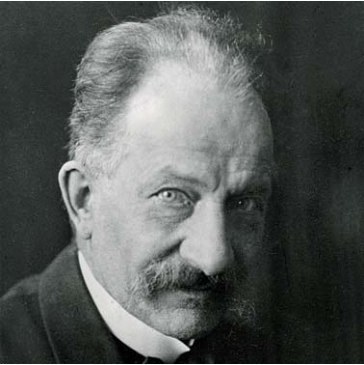
Paul Walden
1863 – 1957
- Cemetery
- Waldfriedhof, Tübingen, Germany, as reported by the book
Paul Walden, also known as Pauls Valdens, investigated how chemical transformations relate to the spatial arrangement of molecules. The reaction phenomenon named Walden inversion became an important reference point in stereochemistry. His research also contributed to the study of non-aqueous solutions and their electrical behaviour. Much of his productive early career was associated with Riga’s technical institutions, where he taught and held senior responsibilities. He later worked in Germany and wrote about the history of chemistry. His life crossed the political and linguistic boundaries that shaped Baltic scholarship in the twentieth century. The enduring value of his work lies in questions that travelled across those boundaries: how reactions proceed, how solvents influence them, and how scientific knowledge develops over time. Born on 26 July 1863 in Cēsis District, Walden was the thirteenth child of a farming family from Rozula. His upbringing and schooling took place in a German-speaking environment. After attending schools in Cēsis and Riga, he completed the chemical technology course at Riga Polytechnicum with honours in 1888. He studied under Wilhelm Ostwald and earned his doctorate in Leipzig in 1892. His teaching career in Riga began in 1889, and he held a professorship at the Riga Polytechnical Institute from 1895 to 1919. [2] His responsibilities extended to the development and administration of the institute. He served as director in 1902–1905 and again in 1917–1918. He also initiated and actively assisted the construction of a laboratory building, completed in 1898 to a design by the institute’s architecture professor Johann von Koch. His lectures attracted listeners from other faculties as well as chemistry students. Election to full membership of the St Petersburg Academy of Sciences in 1910 brought an additional responsibility: managing its chemistry laboratory while retaining his professorial duties in Riga. [2] Several distinct investigations marked these years. In 1897 he identified autoracemisation, adding another subject to his studies of stereochemical change. He used the optical activity of oil as evidence for an organic origin. His investigations of liquids included the discovery of fifty polar non-aqueous solvents and research into the processes occurring within them. In 1905 he formulated the relationship known as Walden’s rule or the Walden product. He introduced the term “solvation” that year and “solvolysis” in 1909. Beyond experimental chemistry, he proposed a citation-based method for assessing a scientist’s significance in 1911. [2] Walden’s public and institutional activities continued through war and revolution. In 1915 he presided over the fifth International Congress of Chemists in Petrograd. His account of chemistry’s development in Russia appeared there in 1917. The following year, acting on Lenin’s instructions, he organised and administered a scientific and technical institute concerned with food in Moscow. His popular-science collection Science and Life appeared in three volumes between 1918 and 1921. In 1919, during the transformation of Riga’s technical institute into the higher-education institution that became the University of Latvia, he was appointed its first rector. That same year he moved to a professorship at Rostock. [2] At Rostock, his research in non-aqueous electrochemistry continued until 1934. His later writing concentrated on chemistry’s history and philosophy, including an investigation of the relationship between researchers’ ages and their discoveries. A history of organic chemistry appeared in 1941, followed by a book concerning Goethe and science in 1943. An air raid in 1942 destroyed his Rostock home, possessions and scientific archive. He subsequently lived in Frankfurt am Main before moving to Gammertingen in 1947. He lectured on chemical history at Tübingen in 1947 and from 1950 to 1953, continuing to the age of ninety. [2] Recognition included seven Nobel Prize nominations, membership of seven academies and honorary doctorates from four universities. Walden died in Gammertingen on 22 January 1957 and was buried in Tübingen’s Waldfriedhof Cemetery. In Latvia, Gustavs Vanags and Alfrēds Ieviņš were among the prominent chemists who continued the scientific traditions associated with his school. Commemoration in Riga has included the Paul Walden Medal, awarded since 1988, and organic chemistry symposia held regularly since 1998. A monument by sculptor A. Vārpa near the former chemistry faculty building represents the molecular inversion bearing his name. [2]
The book A Hundred Great Latvians, which includes this person, can be purchased here.
The map marker shows the cemetery; the exact grave position is not yet established.
Sources & Further Reading
Books
- [2] Apinis, P. A Hundred Great Latvians. Nacionālais apgāds, Riga, 2006, pp. 52-53. ISBN 9984-26-288-X.
Web resources
- [1] Paul Walden