
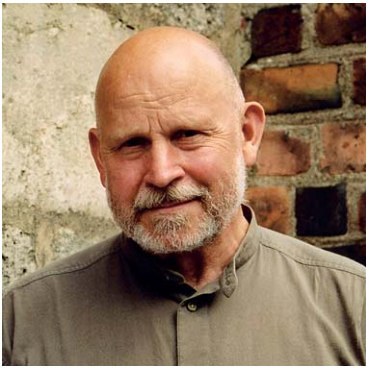
Pēteris Vasks
1946 –
Pēteris Vasks developed a musical language in which lyrical expression often meets tension and fragility. Trained as a double bassist as well as a composer, he wrote for strings, orchestra, chamber ensembles and choirs. His music has reached international audiences through collaborations with prominent performers. Nature, spiritual searching and the experience of Latvia have frequently provided contexts for discussing his work. These themes do not replace the music's formal craft: texture, contrast and the unfolding of a phrase remain central to its effect. His career shows how compositions shaped by a particular cultural experience can communicate across national boundaries and become part of an international concert repertoire. Born on 16 April 1946, Vasks grew up in the family of a Baptist minister. Under Soviet rule, his father's religious position prevented his admission to the Latvian State Conservatory. His initial professional qualification therefore came from Lithuania: in 1970 he completed Vytautas Sereika's double-bass class at the Lithuanian State Conservatory in Vilnius. He subsequently studied composition with V. Utkin in Latvia, graduating in 1978. His education thus involved two conservatories and separate courses of study in instrumental performance and composition, with access to the first Latvian institution constrained by official treatment of his family background. [2] Restrictions also affected his ability to travel. Vasks did not join the Communist Youth Organisation, remained outspoken, and was not allowed to leave the Soviet Union. Nevertheless, performances of his demanding scores had begun attracting accomplished musicians during the 1970s. The chapter names Gidon Kremer, David Geringas, the Hilliard Ensemble and the Kronos Quartet among the interpreters associated with his work. By the following decade, commissions from abroad accounted for most of his output. International professional connections therefore developed even while the composer himself remained subject to Soviet travel controls. [2] The chapter describes an early reception that placed his compositions alongside Eastern European spiritual minimalism and musical mysticism. From 1996, as recordings multiplied and audiences expanded, it identifies a more forceful, modern character that exceeded those categories. Bird calls and elements of Latvian folk song appear in several scores. Contrasts between mortality and life, forgiveness and hatred, and order and disorder recur in its account of his concerns. At the same time, Vasks combined different twentieth-century compositional techniques with an interest in renewing the expressive resources and values of classical music. [2] Recordings became an important means of circulation from 1994 onward, with releases on labels including ECM, Wergo, BIS and Teldec. The chapter records more than twenty CDs and a publishing contract with Schott Musik International. Finlandia's 1999 release of Tālā gaisma, or Distant Light, appeared among Amazon's ten best albums. In 2003, Grammy nominations recognised the Kronos Quartet's recording of his Fourth String Quartet and Baltic Voices 1, a choral collection that included his music. An Ondine recording pairing the Second Symphony with Distant Light received a Cannes Classical Award in 2004 in the twentieth-century orchestral category. [2] Performances extended across major symphony orchestras, chamber ensembles and choirs. Among the orchestras listed are the Berlin Philharmonic, the BBC Symphony Orchestra and the Boston and Sydney symphony orchestras; smaller groups include the Ostrobothnian Chamber Orchestra and Kremerata Baltica. Vasks also participated in the Stockholm New Music Festival and Austria's Lockenhaus festival, served as composer in residence and led master classes. Choreographers used several of his compositions for original ballet productions. These activities placed his scores in educational and theatrical settings as well as concert programmes and recorded collections. [2] Alongside this international activity, the chapter places Vasks in Riga, composing and teaching composition at the Emīls Dārziņš Music School, where numerous students studied with him. Recognition included the Jānis Ivanovs Prize in 1989, the Herder Prize and Baltic Assembly Award in 1996, and Latvian Great Music Awards in 1993, 1997 and 2000. He received the Order of the Three Stars in 2002. Honorary memberships of the Latvian Academy of Sciences and the Royal Swedish Academy of Music, together with an honorary senatorship at the Latvian Academy of Culture, further marked his standing in cultural and academic institutions. [2]
The book A Hundred Great Latvians, which includes this person, can be purchased here.
Sources & Further Reading
Books
- [2] Apinis, P. A Hundred Great Latvians. Nacionālais apgāds, Riga, 2006, pp. 190-191. ISBN 9984-26-288-X.