
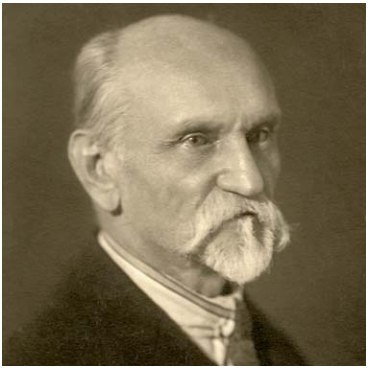
Rainis
1865 – 1929
- Cemetery
- Rainis Cemetery / Raiņa kapi, Riga, Latvia
Rainis, born Jānis Pliekšāns, used poetry and drama to examine personal transformation, freedom and collective responsibility. Trained in law, he became involved in journalism and the New Current movement before political repression sent him into exile. His literary career developed through periods in Russia and Switzerland, alongside his partnership with Aspazija. Works including Uguns un nakts and Zelta zirgs brought symbolic stories into debates about the future of Latvian society. Returning in 1920, he also participated in parliamentary and educational life. His influence cannot be reduced to one political interpretation: successive generations have returned to his writing for different reasons. He died in Jūrmala in 1929. His burial place in Riga gave its name to Rainis Cemetery, where Aspazija was later buried beside him. The son of Krišjānis and Dārta Pliekšāns, Rainis was born at the Varslavāni farmstead near Dunava on 11 September 1865. His father leased several small manor estates. After completing his law degree at St Petersburg University in 1888, he worked at the regional court in Vilnius in 1889 and subsequently as a lawyer's assistant in Jelgava. Between 1891 and 1895 he edited Dienas lapa. These early appointments placed him successively within legal institutions and the newspaper world before poetry and political activity became the principal subjects of his public reputation. [2] His acquaintance with Aspazija began in 1894, when she was already recognised as a playwright. The chapter credits her with encouraging him to regard the verse he wrote privately as serious artistic work. He also brought social-democratic literature from Switzerland into Latvia, contributing to the movement's intellectual foundations. In 1897, while practising law in Panevėžys, he was arrested on 31 May. He and Aspazija married in prison that Christmas and went to temporary exile in Pskov. A sentence imposed in April 1899 sent him to Slobodsk in Vyatka province, where he wrote his first poetry collection, Tālas noskaņas zilā vakarā. [2] Permission to return came in 1903. His subsequent writing and political activity were closely associated with the revolution of 1905, including the collection Vētras sēja. After the revolution's suppression, the danger of arrest forced the couple to leave in December 1905. They settled in Castagnola, now part of Lugano. The Swiss years produced a substantial body of dramatic writing: Indulis un Ārija appeared in 1912, Pūt, vējiņi! in 1914, Spēlēju, dancoju in 1915, and Jāzeps un viņa brāļi in 1919. The chapter identifies the last of these as a tragedy distinguished by its philosophical concerns. [2] His range extended beyond drama and revolutionary verse. The collection Gals un sākums, published in 1912, and Dagdas piecas skiču burtnīcas, issued during 1920–1925, contained love poetry and reflections on life's meaning. During the First World War he wrote Daugava, which the chapter connects with the prospect of a Latvian national state. Translation was another significant part of his literary work. His Latvian versions of Goethe's Faust and Pushkin's Boris Godunov receive particular recognition in the source, which also records translations of Ibsen, Byron, Shakespeare and Schiller. [2] Thousands welcomed Rainis and Aspazija when they arrived in Latvia in April 1920, shortly before elections to the Constituent Assembly. Both won seats, Rainis standing with the Social Democrats and Aspazija without party affiliation. In the contest for the assembly chairmanship, Jānis Čakste defeated Rainis by eighty-three votes to forty-three; Čakste also prevailed when Rainis was proposed for the presidency in 1925. Rainis served as Minister of Education from 1926 to 1928. His cultural responsibilities were equally concrete: he helped found the Dailes Theatre and became its first managing director in 1920, then directed the National Theatre from 1921 to 1925. [2] The chapter documents a legacy sustained both through performance and through competing claims upon his poetry. Several plays remained established works on Latvian stages, while the breadth of his verse allowed different political authorities to emphasise different elements. Soviet interpreters, in particular, drew upon the revolutionary content of Vētras sēja and Klusā grāmata to present him as their own poet. Latvian supporters also nominated him for the Nobel Prize, although he died before the nomination was considered. His documented reception therefore encompasses theatrical continuity, international aspirations for recognition and sharply selective political readings of a varied literary achievement. [2]
The book A Hundred Great Latvians, which includes this person, can be purchased here.
The map marker shows the cemetery; the exact grave position is not yet established.
Sources & Further Reading
Books
- [2] Apinis, P. A Hundred Great Latvians. Nacionālais apgāds, Riga, 2006, pp. 58-59. ISBN 9984-26-288-X.