
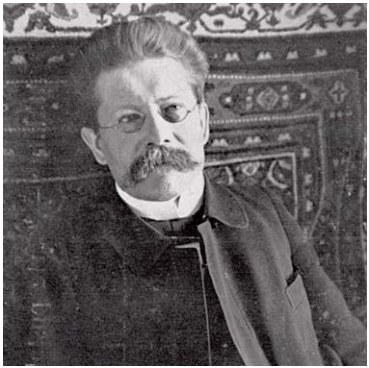
Rūdolfs Blaumanis
1863 – 1908
- Cemetery
- Ērgļi Cemetery, Latvia
Rūdolfs Blaumanis brought close observation of rural life into Latvian short fiction and drama. His characters face difficult choices shaped by money, loyalty, family expectations and desire. The emotional precision of those conflicts helped his work remain meaningful beyond the circumstances in which it was written. Braki, his family home near Ērgļi, supplied an important setting for his imagination, while journalism connected him with the literary world of Riga. Plays such as Skroderdienas Silmačos became part of Latvia’s recurring theatrical culture. He also encouraged younger writers and maintained exchanges with artists and musicians. His career was cut short by tuberculosis; he died in Finland and was brought home for burial. Born on 1 January 1863 in accommodation for servants at Ērgļi Manor, Blaumanis studied in Riga before briefly taking employment as a manor manager in Koknese. From 1887, he concentrated on writing in Riga. His living arrangements there were changeable: he rented furnished rooms from acquaintances or people he did not previously know, and sometimes stayed in inexpensive hotels. These circumstances differed from his enduring attachment to the Braki farmstead. The chapter identifies Braki not simply as a residence but as the place associated with the creation of many of his works. [2] His literary education drew extensively on German-language reading. Fluent in German, he read works in their original form and sometimes used the language for his own writing. His range of literary reference included Goethe, Schiller, Dickens, Shakespeare and Ibsen. This engagement with European writing accompanied his use of Latvian folklore and his attentive listening to rural speech. In developing his work, he also reworked ideas associated with the Latvian National Awakening, including cultural confidence and national identity, rather than relying on those ideas in an unchanged form. [2] During the 1890s, his stories established him as a writer particularly concerned with the individual and the conflicts within a person’s emotional life. The chapter assigns him a foundational role in Latvian short fiction and psychological drama. Among the stories it singles out are Pērkona negaiss, Raudupiete, Salna pavasarī, Purva bridējs, Andriksons and Nāves ēnā. These works later reached audiences through screen adaptations shown in numerous countries. His plays likewise travelled beyond Latvia to theatres in neighbouring countries, while Pazudušais dēls, Ugunī and Indrāni remained established works on the Latvian professional stage. [2] Poetry formed another substantial part of his achievement. The chapter credits him with at least a hundred poems in his principal lyric output, approximately 150 humorous and satirical poems, and about a hundred poetry translations, predominantly from German. His range included love and nature poetry, ballads, elegies, parody and other forms. Composers including Alfrēds Kalniņš, Emīls Dārziņš, Emilis Melngailis and Andrejs Jurjāns set his words to music; later settings included those by Raimonds Pauls and Imants Kalniņš. Some of his poetry became so widely familiar that it entered popular tradition. [2] His public writing included theatre criticism, satire and literary sketches published in both Latvian and German newspapers. An extensive correspondence linked him with people from differing social backgrounds, although cultural figures formed the largest part of his circle. Among those he advised and supported were Kārlis Skalbe, Jānis Akuraters and Emilis Melngailis. His friend Aleksandrs Būmanis composed music for Skroderdienas Silmačos and Trīnes grēki. Such relationships placed his work within exchanges among writers, performers, artists and composers, with Blaumanis acting both as a critic of younger talent and as a source of encouragement. [2] On 4 September 1908, Blaumanis died at the Takaharju Sanatorium in Finland. His remains were returned to Latvia and buried in Ērgļi Cemetery. Places associated with his working life subsequently became sites of remembrance: Braki houses a memorial museum, while the Riga apartment he shared with artist Janis Rozentāls, at 12 Alberta Street, also became a museum. His theatrical legacy continued in performance. A photograph reproduced in the chapter records Berta Rūmniece and Aleksis Mierlauks in a 1920 Latvian National Theatre production of Indrāni, documenting that continuing stage life after his death. [2]
The book A Hundred Great Latvians, which includes this person, can be purchased here.
The map marker shows the cemetery; the exact grave position is not yet established.
Sources & Further Reading
Books
- [2] Apinis, P. A Hundred Great Latvians. Nacionālais apgāds, Riga, 2006, pp. 50-51. ISBN 9984-26-288-X.