
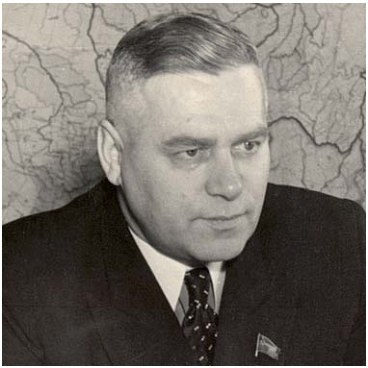
Vilis Lācis
1904 – 1966
- Cemetery
- Forest Cemetery / Meža kapi, Riga, Latvia
Vilis Lācis gained a large readership through accessible, dramatic fiction, particularly Zvejnieka dēls. His background in working communities helped shape subjects that appealed to readers in interwar Latvia. Literary popularity was followed by a very different kind of public power. After Soviet occupation in 1940, he became a senior official in the new regime and later headed the government of Soviet Latvia. His role in an administration responsible for repression and deportation is an essential part of his biography. Inclusion in this collection records historical influence, not endorsement: the achievements of a novelist must not be used to conceal the consequences of his political responsibilities. Born on 12 May 1904 on the outskirts of Riga, Lācis was the son of a port worker. During the First World War, his family became refugees in the Altai region of Siberia. There he attended Barnaul Pedagogical Seminary while also serving as secretary to a village council. He returned to Latvia in 1921 and earned his living in several occupations, working as a fisherman, dock labourer, ship’s fireman and librarian. During the 1920s and 1930s he also participated in clandestine left-wing political activity. [2] His emergence as a novelist was rapid. Atbrīvotais zvērs (The Beast Is Free) appeared in 1931, followed by Putni bez spārniem (Birds without Wings) in 1932 and Zvejnieka dēls (The Fisherman’s Son) in 1934. An effective command of language, rapidly developing plots and sustained dramatic tension distinguished his fiction. He continued producing novels and short stories throughout the remaining years of independent Latvia. His relationship with the interwar establishment included support from Public Affairs Minister Alfrēds Bērziņš, who promoted his employment at the newspaper Jaunākās Ziņas and arranged financing for the screen adaptation of Zvejnieka dēls in 1939. The film reached audiences in 1940. [2] His newspaper work also included a text published on 11 May 1939 praising Kārlis Ulmanis’s overthrow of the government five years earlier. After the Soviet occupation began on 17 June 1940, Lācis received the internal affairs portfolio in the administration installed by the occupying power. The ensuing repression included the imprisonment and execution of prominent public figures. Orders for the deportation of 14,428 people on 14 June 1941 bore his signature. Although the decision originated in Moscow, his participation in authorising its implementation in Riga formed a direct part of his official record. [2] Evacuated to Moscow during the war, Lācis continued writing and revised earlier works to bring them into line with Soviet ideology. His fiction became associated with socialist realism, especially its exemplary central characters and pronounced division between approved and condemned figures. From 1944 to 1959 he headed the Latvian SSR’s Council of Ministers. His responsibility as head of government encompassed the deportation of more than forty thousand people from Latvia to Siberia and other distant Soviet regions in 1949. Literary production continued alongside these government duties, rather than replacing them. [2] Soviet institutions rewarded Lācis extensively. He received the Order of Lenin seven times and the Stalin Prize twice, and became one of the Soviet Union’s most extensively published writers. Eight films based on his writings were made during the Soviet period, including another adaptation of Zvejnieka dēls in 1957. His novels appeared in forty-four languages, while a twenty-six-volume collected edition was issued between 1970 and 1980. In the late 1950s he supported proposed reforms associated with Eduards Berklavs and the Latvian national communists. He was subsequently compelled to retire in 1960. [2] Lācis died on 6 February 1966 and was buried in Riga’s Meža kapi. His monument, erected in 1974, incorporates the figure of the Fisherman’s Son, linking his burial place to his best-known fictional creation. Its position obstructs the view towards the monument of Latvia’s first president, Jānis Čakste, at the end of the cemetery’s central avenue. The cemetery thus preserves both the literary image selected for his commemoration and a conspicuous spatial relationship with a memorial to the independent Latvian state. [2]
The book A Hundred Great Latvians, which includes this person, can be purchased here.
The map marker shows the cemetery; the exact grave position is not yet established.
Sources & Further Reading
Books
- [2] Apinis, P. A Hundred Great Latvians. Nacionālais apgāds, Riga, 2006, pp. 120-121. ISBN 9984-26-288-X.
Web resources
- [1] Vilis Lācis